

Symptom Radar helps identify early signs of strain in your body, empowering you to take proactive steps toward rest and recovery.
How Symptom Radar Works
Symptom Radar looks for changes in your Oura data that may indicate something is straining your body. In addition to the 50+ wellness metrics that Oura tracks, Symptom Radar monitors specific metrics over time, such as skin temperature, average temperature trends, respiratory rate, resting heart rate, heart rate variability, and inactive time, along with demographic information such as age.
A deviation in a combination of these metrics over time may indicate that you should focus on rest in the upcoming days, which improves your immune system responses and allows your body to recover from strain.
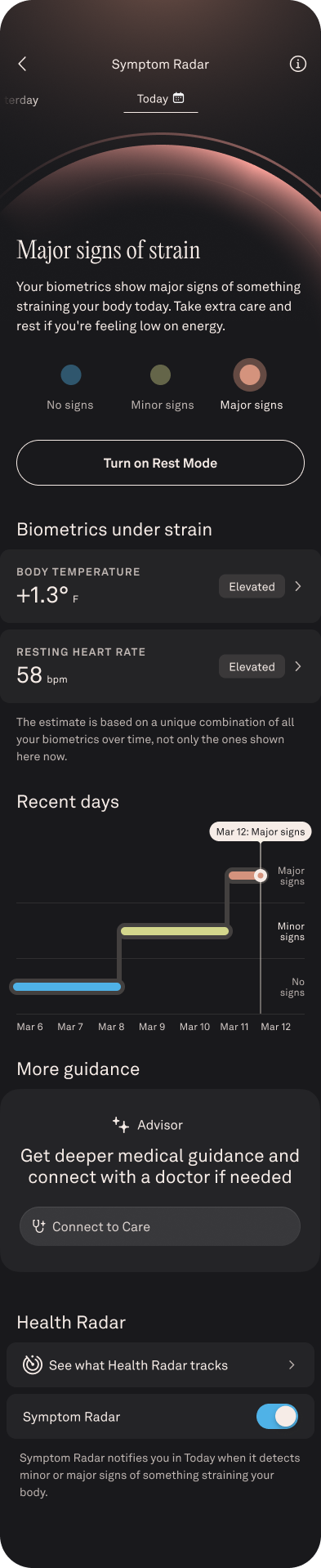
The Oura App displays signs of strain in a three-level estimate: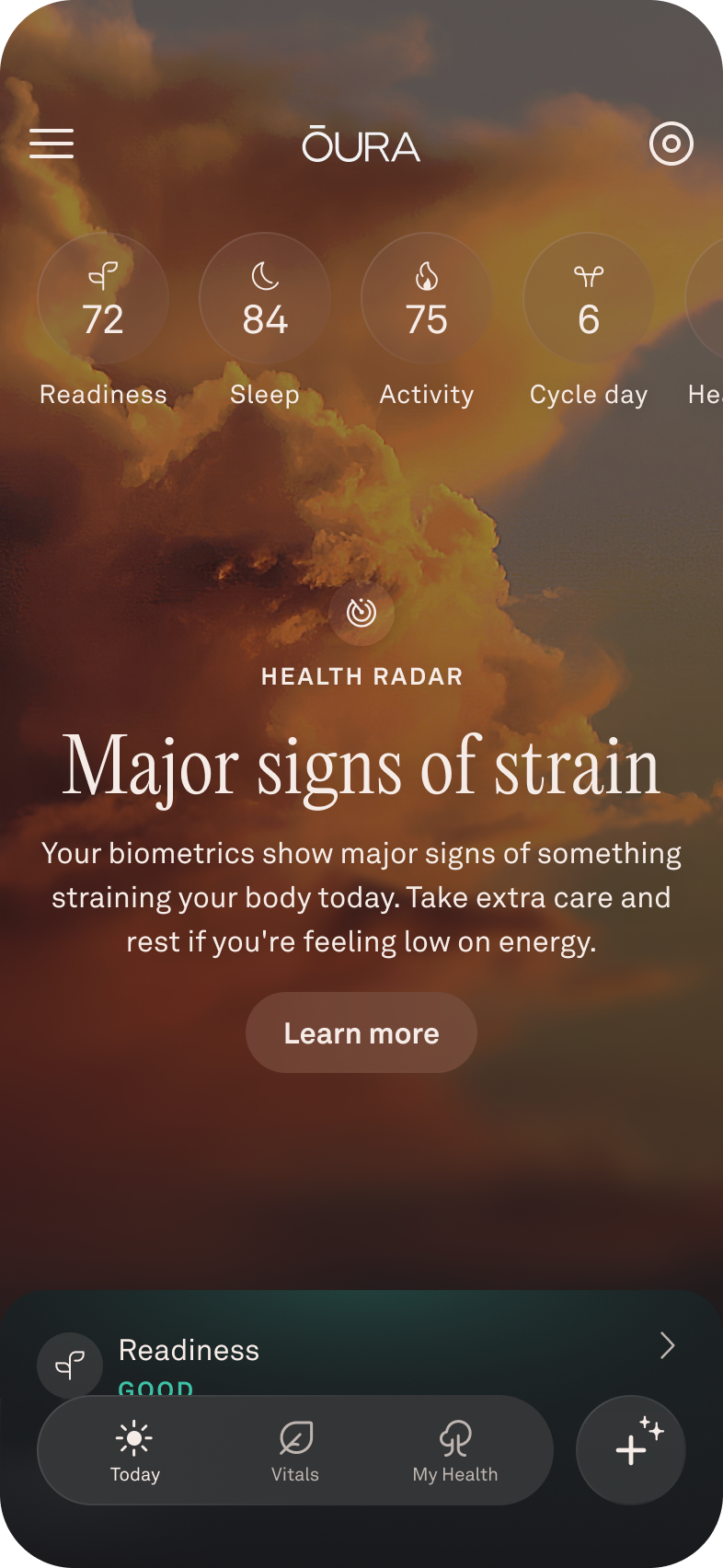
- No signs: There are no obvious signs in your biometrics of something straining your body
- Minor signs: There are small signs in your biometrics of something straining your body
- Major signs: There are stronger signs in your biometrics of something straining your body
To help you understand why you may be seeing minor or major signs of strain, Oura highlights biometrics from the previous night that show a significant deviation from your baseline. Because Symptom Radar monitors changes in your biometrics over time, it may detect subtle signs of strain, despite your biometrics being within their usual range.
If you choose, you can enable Rest Mode, which pauses your Activity Score, goal, and all activity contributors. This can help you focus on getting the restorative rest that your body needs to fight off illness and boost your immune system, rather than achieving a step count or caloric burn goal. Symptom Radar will continue to monitor your metrics even with Rest Mode activated.
Important notes:
- Your Readiness Score may not always correlate with Symptom Radar. Symptom Radar is designed to detect potential early signs of strain on your body, and may indicate signs of strain before they are reflected in your Readiness Score.
- Symptom Radar may not work optimally with pre-existing medical conditions. Pregnancy also impacts biometric baselines and may reduce the accuracy of Symptom Radar. Pregnant members can turn off the feature for the duration of their pregnancy.
- The Oura Ring is not a medical device and is not intended for use in the diagnosis of disease or other conditions, or in the cure, mitigation, treatment, or prevention of disease. Please do not make any changes to your medication, daily routines, nutrition, sleep schedule, or workouts without first consulting your doctor or another medical professional.
What’s Happening in Your Body When You’re Getting Sick
When you get sick, your immune system has a lot of strategies it can deploy to help you heal. This usually shows up as signs of strain in your body.
1. An increase in skin temperature or average temperature trends
When your immune system responds to an infection, it can trigger a rise in your temperature—sometimes enough to cause a fever.
2. An increase in respiratory rate
If a respiratory infection is challenging your system, you may see an elevated respiratory rate in the Oura App. A typical respiratory rate for a healthy adult at rest is 12–20 breaths per minute. Read more about what can impact respiration here.
3. An increase in resting heart rate, or a drop in heart rate variability
As your body fights an illness, it engages your sympathetic, fight-or-flight nervous system. Fighting an infection takes energy, and a rising temperature also pushes your heart to beat faster. Together, these can raise your resting heart rate and lower your heart rate variability, a sign that your body is spending less time in its rest-and-recover state.
4. More Inactive Time
It’s common to feel sluggish when you’re coming down with an illness. Fighting an infection requires an immense amount of metabolic energy. By inducing fatigue and lethargy, your brain forces you to rest so your body can redirect all its fuel to the immune response.
RELATED: How Oura Ring Data Could Help Identify Early COVID-19 Symptoms
The Development of Symptom Radar
The groundwork for Symptom Radar began back in 2020, when the University of California, San Francisco (UCSF), launched t
he TemPredict study. Based on our initial algorithm, Oura introduced the Health Risk Management (HRM) platform for select enterprise clients, designed to support workforce safety.
For several years, Oura’s Science and Data Science teams continued work on improving the algorithm, ensuring it was more responsive, efficient, and accurate for alerting members to signs of strain on their body.
In April 2024, Symptom Radar was introduced in Oura Labs. When opted in, members could test the feature and provide direct feedback to developers. After listening to and iterating on member feedback, we launched the full Symptom Radar feature to Oura members in December 2024.
READ MORE: Inside the Ring: Developing Symptom Radar
How to Use Symptom Radar Alongside Health Radar
Symptom Radar is now part of Health Radar, Oura’s broader set of features for noticing long-term changes in your health metrics. Symptom Radar watches for short-term strain while Health Radar’s newer features, Blood Pressure Signals and Nighttime Breathing, look at longer-term patterns across 30-day periods.
Symptom Radar is turned on by default for Oura members with an active Oura Membership. Among other inputs, the feature uses your sleep data (at least seven nights within the past 14 days) to check for signs of strain on your body. If there is a clear sign of strain, it will be spotlighted on the Today screen the following morning. In that case, you can tap on the Symptom Radar card to see more detail.
You can also access Symptom Radar at any time by selecting the menu in the upper-left of the Today screen and then selecting Symptom Radar. Symptom Radar can be toggled on or off at any time from the detail screen.
RELATED: 9 Ways to Support Your Immune System
Frequently Asked Questions About Symptom Radar
Can a smart ring tell if you’re getting sick?
A smart ring can’t diagnose illness, but it may pick up signs of strain before you feel them. Symptom Radar uses a machine learning model, with the member’s last 30 days of biometrics and demographic information as inputs. In some cases, the model’s prediction may be driven largely by deviations from baseline, but it may equally be picking up on more subtle multivariate patterns that aren’t reducible to individual metric deviations.
How does Symptom Radar detect signs of illness before you feel symptoms?
Symptom Radar looks at how several metrics change over time rather than checking whether any single reading is abnormal. Because it compares your data against your own baseline and looks for combined patterns, it can register subtle shifts even while each metric is still within its usual range.
What’s the difference between Symptom Radar and my Readiness Score?
They measure different things and won’t always agree. Symptom Radar is built to surface early signs of strain, and may flag them before they show up in your Readiness Score.
Can Symptom Radar tell me what’s making me sick?
No, Symptom Radar identifies that your biometrics have shifted, not why they shifted. The same pattern of raised temperature, higher resting heart rate, and lower heart rate variability can be produced by an infection, a poor night’s sleep, alcohol, intense training, jet lag, GLP-1s, vaccines, pregnancy, or stress.
How much data does Symptom Radar need before it works?
Symptom Radar uses at least seven nights of sleep data from the past 14 days. It’s on by default for members with an active Oura Membership, and can be toggled off at any time from the detail screen.
Can Oura track my immune system?
No wearable measures immune function directly. Oura measures physiological signals like temperature, respiratory rate, cardiovascular metrics, and activity, which can shift when your body responds to strain, including infection. It’s an indirect signal, not a measure of immune status.
How can I tell if I’m recovering after being ill?
You can review whether the metrics that shifted during your illness are returning toward your baseline. Oura Members can use Rest Mode to pause your Activity Score while you can focus on recovery, and Symptom Radar will continue monitoring.
Does Symptom Radar work during pregnancy?
Pregnancy changes your biometric baselines and may reduce Symptom Radar’s accuracy. Pregnant members can turn the feature off for the duration of their pregnancy.