





As popular as the metaphor may be, a healthy heart doesn’t beat as regularly as a metronome. In fact, it changes its rhythm with each beat. Heart rate variability, or HRV, is a measure of the constant variation in milliseconds between your heartbeats.
Some situations increase variation, leading to a higher HRV, while others cause the time intervals between beats to stay more consistent, leading to a lower HRV.
While subtle, these variations reflect your heart’s ability to respond to different situations. HRV can react to stress and/or illness before your resting heart rate (RHR), which makes it one of your body’s most powerful signals—providing useful insights into your stress levels, recovery status, and general well-being.
READ MORE: How Accurate Are Oura’s Heart Rate & HRV Measurements?

HRV and Your Nervous System
In the vast majority of people who do not have heart conduction problems (arrhythmia), HRV reflects the state of your autonomic nervous system (ANS)—specifically, the balance between the parasympathetic nervous system (PNS), also known as the rest-and-digest branch, and the sympathetic nervous system (SNS), known as the fight-or-flight branch.
By balancing the two forces, your ANS helps you respond to daily stressors and regulate some of your body’s most important systems, including heart rate, respiration, and digestion.
Independently, your heart beats to its own rhythm thanks to a built-in pacemaker called the sinoatrial (SA) node. Your SA keeps your heart firing at around 100 beats per minute.
However, your ANS greatly influences how your heart beats. Think of it this way: All the cells within your heart’s pacemaker have direct phone lines from both sides of your ANS. They give input, beat to beat, on a cellular level to your heart.
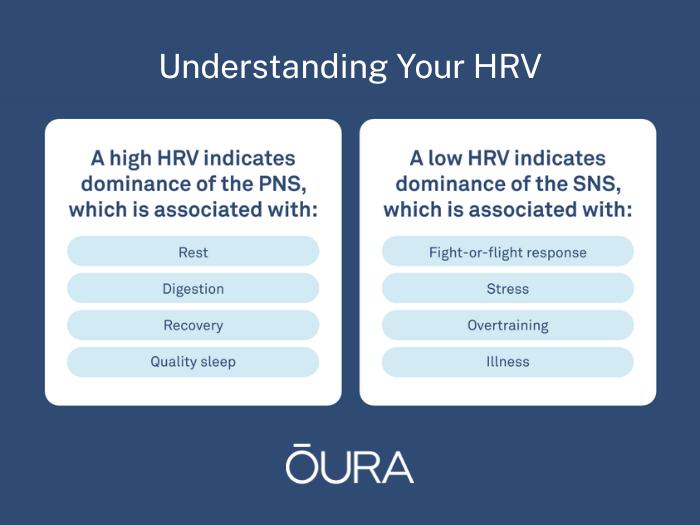
- The PNS, or rest-and-digest system, tells your heart to slow down, making room for variability between beats (higher HRV).
- The SNS, or fight-or-flight system, tells your heart to speed up, limiting space for variability (lower HRV).
These two systems can be silent, active, or shouting over each other at any given time. That’s a lot of conversation, and it leads to a lot of variation.
READ MORE: How Stress Works: The Mind-Body Connection
What HRV Can Show About Stress and Recovery
Heart rate variability reflects the balance between sympathetic and parasympathetic activity, and stress can affect this balance. Acute stress, intense exercise, illness, and poor sleep can increase sympathetic activity and temporarily lower HRV. Rest, recovery, and relaxation can support parasympathetic activity and help HRV return.
You can use a smart ring like Oura to understand how your stress and recovery impact your HRV. Oura’s Readiness Score, Daytime Stress, and Resilience features interpret HRV alongside resting heart rate, skin temperature, movement, sleep, and other biometrics. This approach provides more context than treating a single HRV value as a stress diagnosis.
READ MORE: HRV and Stress: What HRV Can Tell You About Your Mental Health
What Does Higher or Lower HRV Mean?
As a rule of thumb:
- Higher HRV is associated with rest-and-digest, general fitness, and good recovery
- Lower HRV is associated with fight-or-flight responses, stress, illness, or overtraining
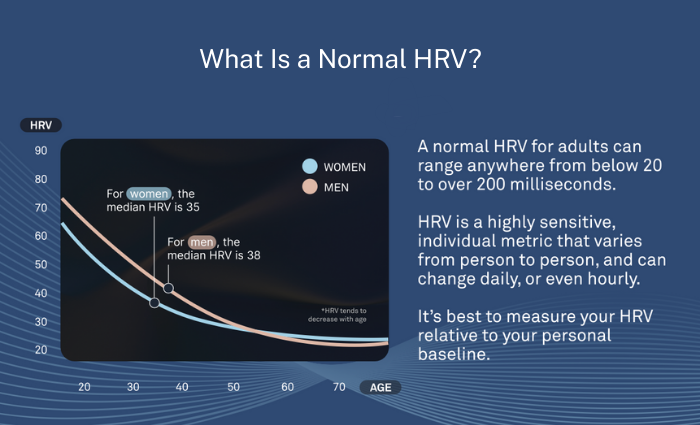
However, keep in mind that your HRV is highly unique to you. “High” and “low” heart rate variability is relative for each person—it’s a very sensitive metric. Some individuals have steady HRV scores, while others fluctuate considerably. It’s normal to see daily and seasonal fluctuations in your HRV, and HRV also naturally changes with age.
While high HRV is generally positive, there are situations where low HRV is necessary and even desirable. For example, during strenuous exercise, low heart rate variability is a reflection of your fight-or-flight system appropriately dominating to get your heart rate up for activity. Your HRV will rebound afterward, as your rest-and-digest system takes over to help you recover.
These fluctuations occur throughout the day, as different daily stressors continuously challenge your system. Simply being excited or moving from the couch to the bathroom can change your HRV at any given moment.
By measuring your HRV during the day, you’re capturing your body’s response to these fleeting changes. If you want to understand your chronic physiological state, the best time to measure HRV is while you sleep. In the Oura App, helpful short- and long-term metrics to track include average daytime and nightly HRV, as well as HRV Balance and HRV over months, which you can access in the Trends view.
Can You Improve Your HRV?
Yes, you can improve your HRV by focusing on healthy lifestyle habits. However, certain factors outside your control can affect your HRV, such as:
- Genetic factors: Your genetic makeup plays a significant role in determining your baseline HRV. Variations in genes mean you have a unique autonomic nervous system, which leads to individual differences in HRV patterns. As a result, you may naturally have higher or lower HRV. While you can’t change your genetic predispositions, it can help you to understand your HRV baseline.
- Age: HRV changes with age. Generally, HRV tends to decrease as you get older. This decline is attributed to various age-related changes in the autonomic nervous system and heart function. Nonetheless, even within specific age groups, individual differences in HRV exist.
- Hormone cycles: Hormone cycles, particularly in women, can influence HRV. Menstrual cycles and fluctuations in sex hormones like estrogen and progesterone can affect the autonomic nervous system and, consequently, HRV. Changes in HRV during different phases of the menstrual cycle are not uncommon.
- Conduction problems: When the cellular “wires” of the heart fire electrical signals abnormally (called arrhythmia), in conditions like atrial fibrillation, HRV is less reflective of your autonomic state and more reflective of the abnormal conduction patterns. As a result, HRV readings during atrial fibrillation can look unusually high. If you’ve been diagnosed with an arrhythmia, especially atrial fibrillation, you may need to interpret your data differently and want to work with your healthcare provider to understand your trends.
- Medications: Several medications have direct or indirect effects on heart rate, and when the heart rate speeds up or slows down, HRV can be affected. Some of these include beta blockers and certain types of anti-depressants.
- Environmental factors: Environmental factors, such as air quality, temperature, and altitude, can influence HRV.
How to Support Your HRV
- Sleep routine: Your internal biological rhythms, such as circadian rhythm and sleep-wake cycle, can affect HRV. For example, a sleep-wake cycle that promotes adequate and restful sleep can result in better HRV, while sleep disturbances and sleep deprivation can lead to decreased HRV. The good news is that you can align your lifestyle with your body’s natural rhythm to enhance your sleep routine and, in turn, HRV.
- Substances: Various substances can influence the autonomic nervous system and, consequently, HRV. For instance, substances like alcohol, caffeine, or certain drugs may increase sympathetic activity and reduce HRV.
- Lifestyle: Your lifestyle choices, including your physical activity, sleep quality, stress management, as well as hydration and dietary habits, all contribute to your distinct HRV patterns. Prolonged mental and emotional stress can keep your sympathetic nervous system heightened into the night, lowering HRV, while positive emotions and relaxation have been shown to raise it.
Curious how other Oura members’ HRV scores stack up? Here, find an analysis of Oura community data, which revealed a range of normal HRV scores across Oura members as well as interesting trends across age and gender.
READ MORE: Tips for Managing Stress
Why Is My HRV Low?
A dip in HRV can have several causes, and most of them come down to something that kept your sympathetic nervous system working harder than usual. When you see a low reading, it may help to ask yourself a few questions. Did you train hard in the last 48 hours? Could your body be fighting off an infection? Did you have alcohol, caffeine, or a large meal late in the day? Have you been short on sleep, or under more stress than usual?
Fighting an infection can raise your resting heart rate and lower your HRV. Your evening habits can also play a role, whether that’s alcohol, a late meal, or late caffeine. Sleep deprivation, disrupted sleep, and an inconsistent schedule can also affect HRV.
Comparing a low signal to your personal baseline can help you understand whether it’s a one-night dip or part of a longer-term trend.
| Member Story: On the Oura App, Jussi L. noticed that alcohol consumption negatively affected his sleep quality and HRV. Using Oura insights, Jussi adjusted his diet and evening routine, leading to a better HRV. “When making all these changes, my Oura stats started to improve,” he says. “My HRV soared to 60 for a period, which for my age is terrific.” |
READ MORE: How To Improve Your HRV (Heart Rate Variability)
Frequently Asked Questions About HRV
What is HRV?
HRV refers to the natural, millisecond-by-millisecond variation in the time between your heartbeats. It’s a key indicator of your nervous system’s balance, showing how well your body adapts to stress and recovers.
What is HRV ms?
HRV ms is simply the measurement of your heart rate variability, and the number you see is expressed in milliseconds (ms). It reflects the tiny, healthy differences in time between each of your heartbeats.
What’s a good HRV?
There’s no single “good” HRV score since it’s highly personal. Healthy HRV levels can range widely from person to person. The most important thing is to track your own average over time. But if you’re wondering what HRV is good or what a healthy HRV is, know that generally speaking, a higher HRV indicates a state of rest and recovery, while a lower HRV can signal stress, illness, or fatigue.
LEARN MORE: What Is the Average HRV?
What is an HRV score?
Oura measures your heart rate variability while sleeping. Each morning when you open the Oura App, you will see your average HRV while sleeping. On Oura, this is known as your Oura HRV score, but beyond Oura, you may also see it referred to as your HRV level or your HRV status.
What factors affect my HRV?
Many factors influence your HRV, including those you can’t control, like genetics, age, and hormone cycles. However, you can positively impact your HRV through healthy habits. Getting enough quality sleep, managing stress, exercising regularly, and staying hydrated all contribute to a healthier HRV.
Why does my HRV fluctuate?
It’s completely normal for your HRV to fluctuate throughout the day and from one day to the next. These changes are a reflection of your body’s natural response to different activities and stressors. For example, your HRV will drop during intense exercise and then rebound as your body recovers.
Can HRV tracking help prevent burnout?
HRV tracking can’t diagnose or prevent burnout, but it may help you notice when your physiological stress levels are high. Sustained stress can keep your sympathetic nervous system engaged, which may show up as lower HRV and a higher resting heart rate over several days or weeks. Keeping an eye on your HRV against your personal baseline can help you spot a downward trend early and prioritize rest, sleep, or a lighter schedule. If you’re feeling persistently exhausted, detached, or unable to recover, talk with a healthcare provider or mental health professional.
How do wearables track stress?
Most wearables don’t measure stress directly. They estimate it from physiological signals your nervous system influences, most often heart rate and HRV, sometimes alongside skin temperature and movement. Oura’s Daytime Stress feature shows how your stress and recovery balance across the day, and Resilience looks at the past 14 days to describe how well your body is recovering from stress over time.