







Every night, you take a rollercoaster ride through different stages of sleep. Though you’re unaware of what goes on as you’re snoozing, your brain and body are in an active state.
Each stage of sleep plays a different role in how you feel the next day. Read on to learn which stage helps your brain, which restores your body, and if you’re striking a good balance between the stages each night.
What Are the 4 Stages of Sleep?
There are three main physiological states our brain and body pass through every day: wake, non-rapid eye movement (NREM) sleep, and REM sleep.
NREM is then subdivided by depth. Under the American Academy of Sleep Medicine (AASM) scoring manual, NREM has three stages — N1, N2, and N3 — distinguished by EEG features such as sleep spindles, K-complexes, and slow waves. Consumer wearables, including Oura, group these into two reported categories:
- Light sleep = N1 + N2
- Deep sleep = N3, also called slow-wave sleep
| Stage | Defining features | When it predominates | Main job |
| Awake | Brief arousals and awakenings; heart rate, breathing, and movement increase | Short episodes, distributed across the night | Normal brief awakenings |
| Light | Your muscles relax, heart rate and breathing slow, temperature drops. | Light sleep represents the majority of total sleep time | Memory + transition to deeper sleep |
| Deep | Heart rate and breathing are lowest and most regular | First half of night | Physical repair and recovery |
| REM | Brain activity ramps up, eyes dart, most muscles go still — you dream. | Second half of the night | Learning, memory, emotional health |
What Happens in Each Stage of Sleep?
Each stage of sleep plays a different role in preparing your body for the next day.
Why Awake Time Matters
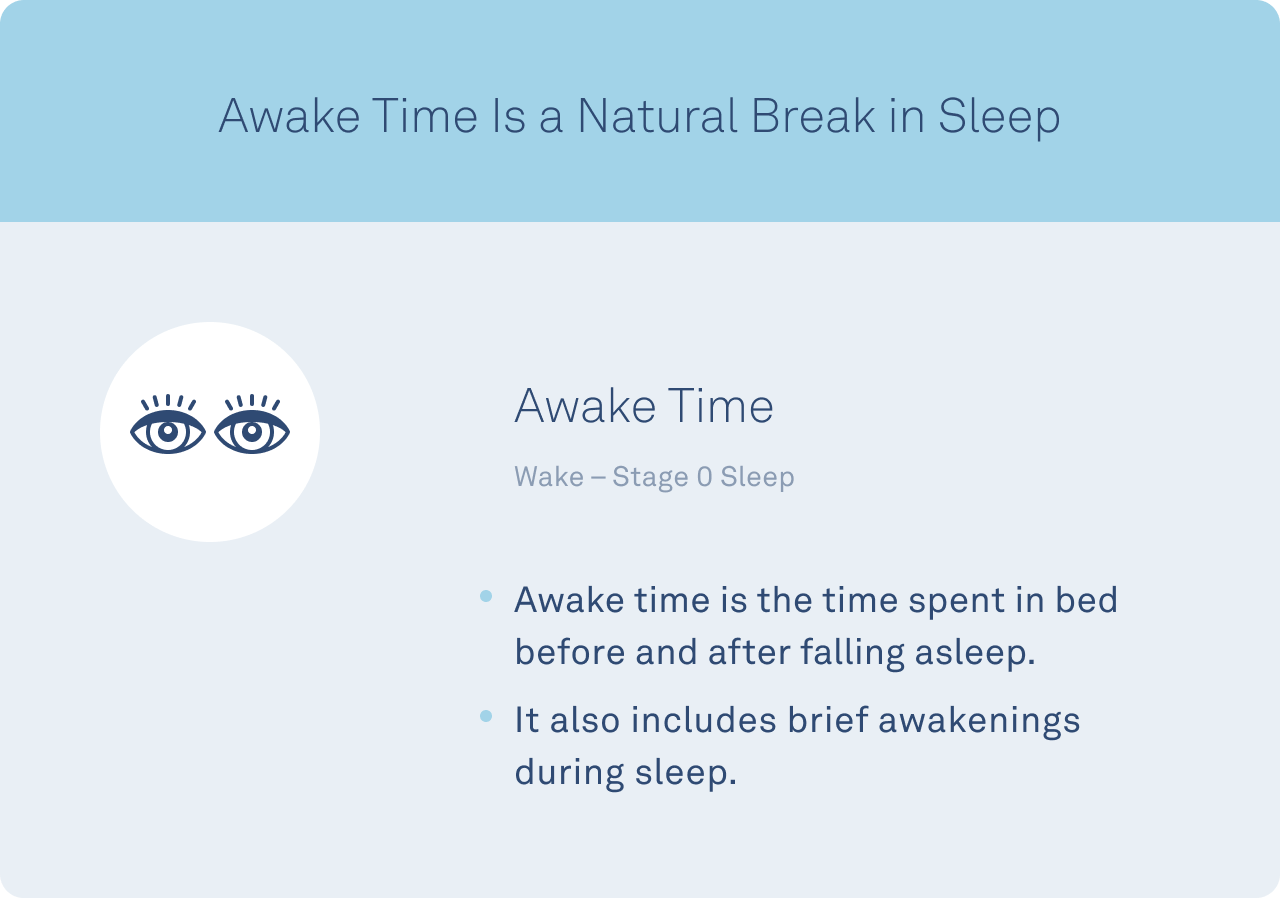
It’s normal to wake up sometimes during the night, whether or not you’re conscious of being awakened.
If you feel refreshed in the morning and energetic during the day, you most likely don’t need to worry about your wake-ups or movement during the night. However, if you’re feeling fatigued, it could be an indication of something that’s affecting your sleep quality, or an untreated sleep disorder like sleep apnea.
If you’re seeing lots of awake time, another indicator to check is your Blood Oxygen Levels and your Breathing Regularity score — learn more about these metrics here.
READ MORE: Restless Sleep? How to Reduce Tossing and Turning at Night
Why Light Sleep Matters
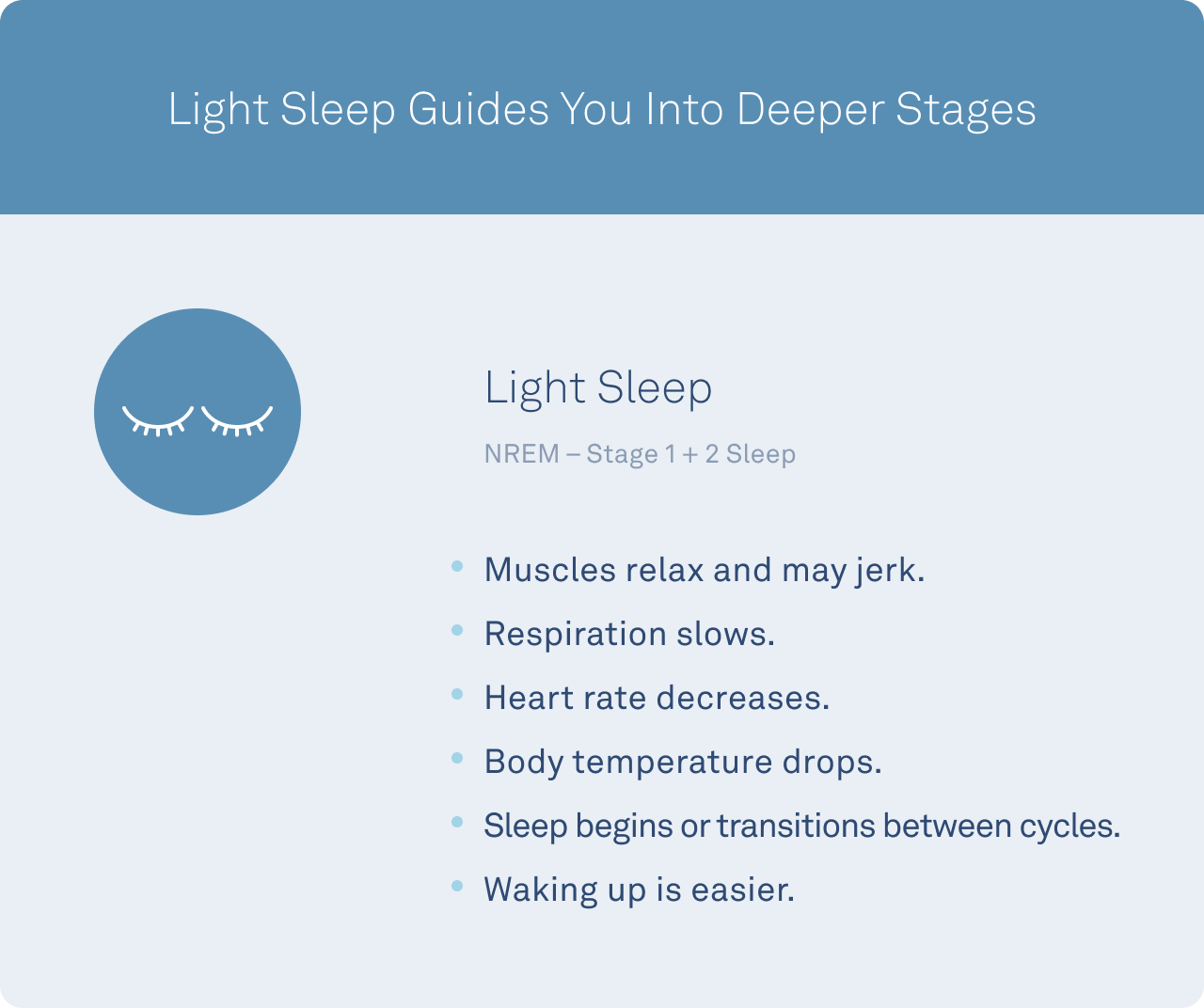
Despite its name, light sleep is not lightweight when it comes to your health. It’s a key stage of sleep that delivers benefits to your brain and body, including codifying memories and boosting creativity. And that’s nothing to sleep on, given that about half of your time asleep — about 50% — is spent in this stage.
Light sleep covers two stages: N1 and N2.
Think of N1 as “falling asleep.” During this time, your muscles relax, your heart begins to slow down, and your body temperature dips. Your brain waves slow down, moving from a regular, rhythmic pattern to one with less frequent, less regular waves. Stage 1 sleep usually only lasts a few minutes.
N2 sleep makes up the bulk of your sleep. During this stage of sleep, your muscles relax and may jerk. Your respiration and heart rate slow down, your body temperature drops, and your brain waves also slow down and increase in amplitude. This is the stage most closely tied to locking in memories and newly learned skills, which is why light sleep matters more than its name suggests.
READ MORE: Light Sleep: What Is It and What Are the Benefits?
Why Deep Sleep Matters
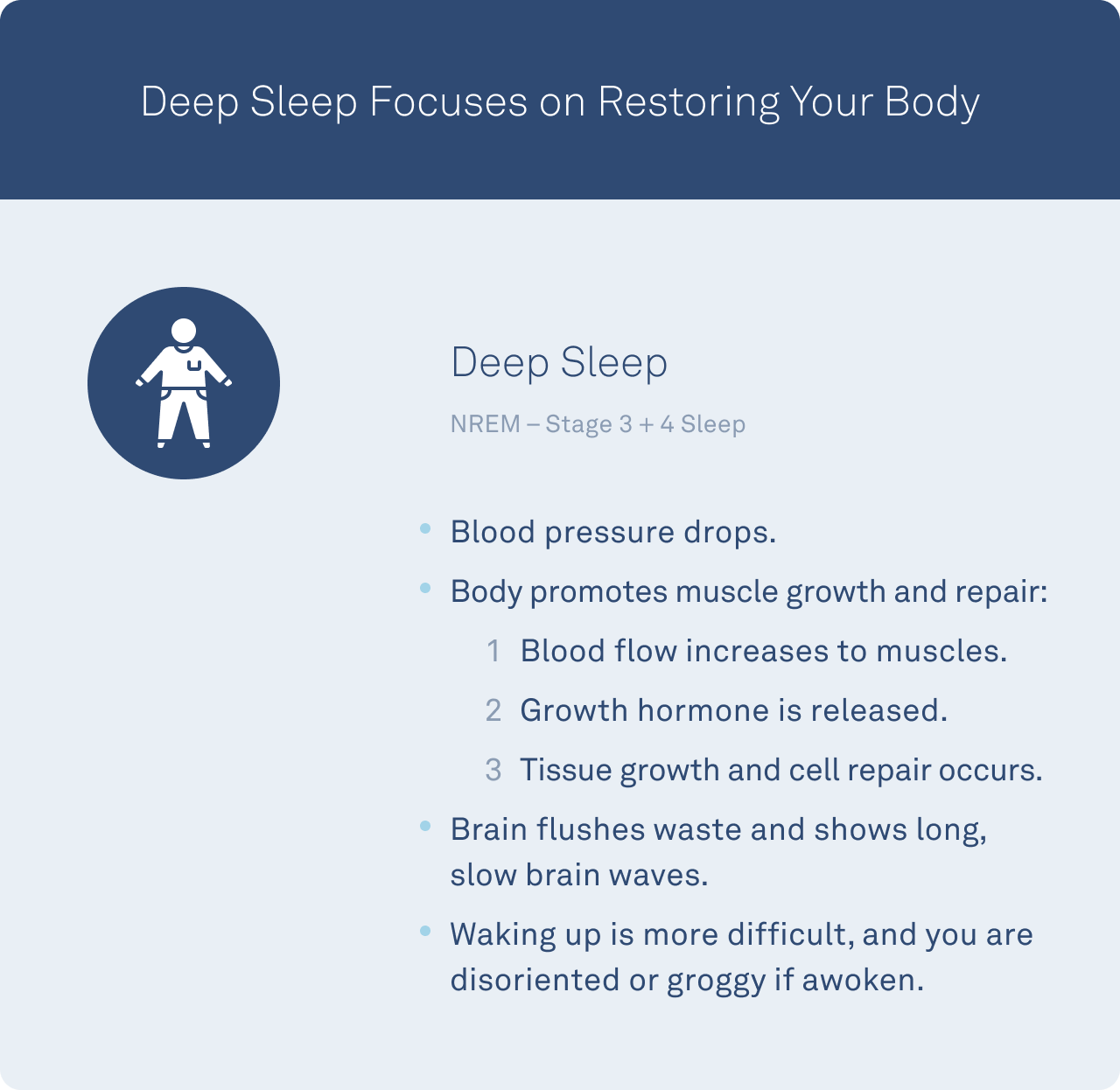
Deep sleep, also known as slow-wave sleep, is the most physically restorative part of the night. It’s when your body gets busy repairing and restoring many systems, from your brain to your muscles.
During deep sleep, your body slows way down. Your heart rate and breathing are at their lowest rate, and your muscles are fully relaxed. Your brain’s electrical activity settles into long, slow waves, hence the name “slow-wave sleep.” It’s difficult to be woken up during this stage — and if you do, you can expect to feel groggy and “out of it.”
Typically, deep sleep occurs within an hour of falling asleep, and you usually get more deep sleep during the earlier part of the night. Growth hormone release peaks during this time. Deep sleep is also the clearest signal of how much sleep your body actually needed: you get more of it after a night of short sleep, and it tapers off as the night goes on.
One thing worth knowing: deep sleep declines steadily with age, starting in early adulthood. Getting less of it at 60 than you did at 25 is expected.
READ MORE: Deep Sleep: What Is It and How to Get More
Why REM Sleep Matters
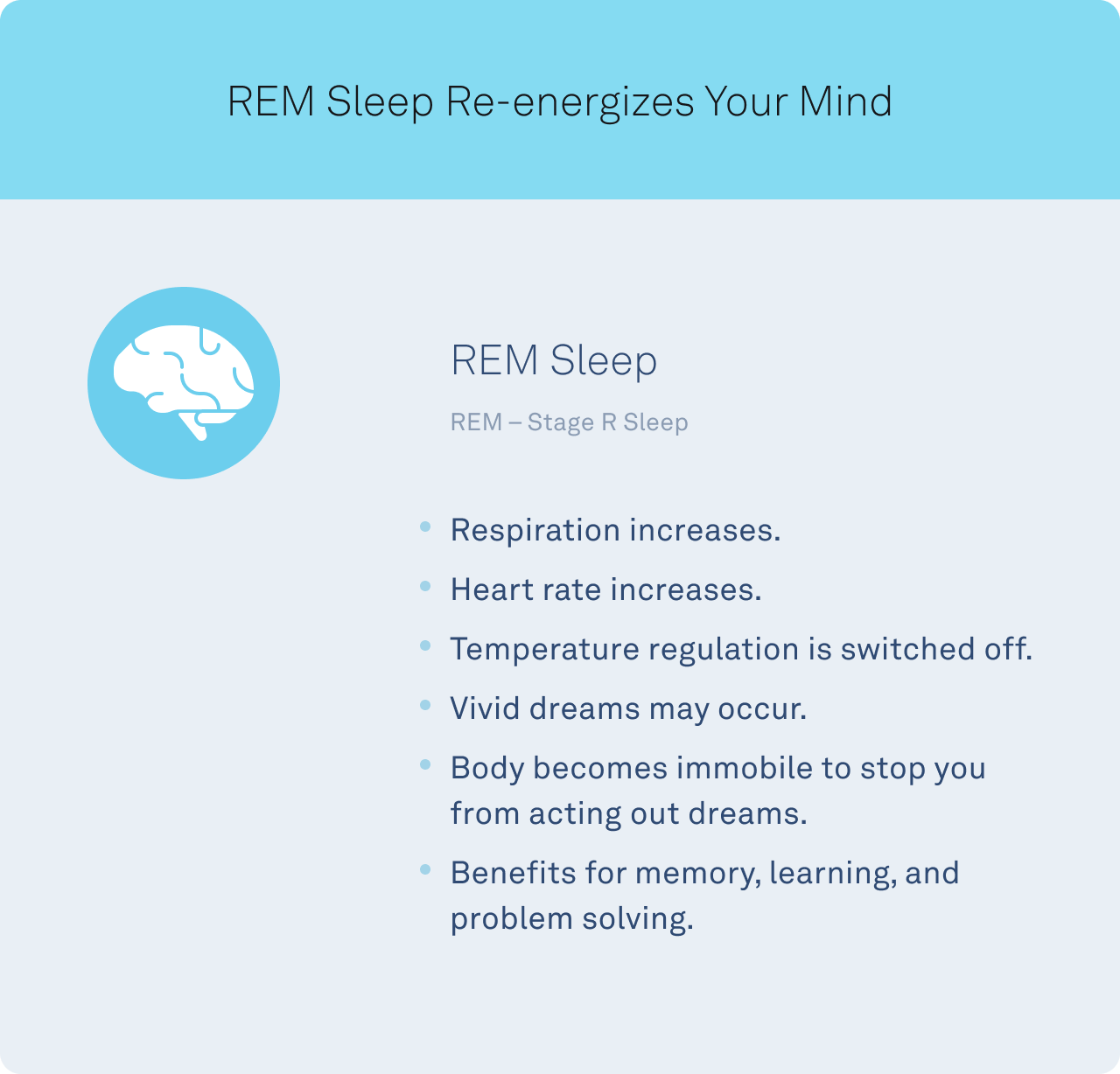
During REM sleep, as the name suggests, your eyes move rapidly behind your closed eyelids. Your heart rate and breathing speed up and become irregular, and brain activity ramps up to levels resembling wakefulness.
Most of the dreams you remember come from REM: roughly 80% of awakenings from REM produce a dream report, compared with about 40% to 50% from other stages. REM sleep is typically associated with the most vivid dreams. During REM sleep, your body switches off nearly all muscle tone, preventing you from moving your limbs while you dream. When this mechanism fails, people start to physically act out their dreams, a condition called REM sleep behavior disorder. You may also experience irregular, jerky muscle twitches in REM sleep.
Research has shown that REM plays an incredibly important role in both emotional health and learning. “Essentially, REM is creating a revised mind-wide web of associations,” explains Matthew Walker, PhD, author of Why We Sleep. “We make connections during REM sleep.” Furthermore, getting enough REM sleep may help mitigate potentially negative emotional reactions.
READ MORE: REM Sleep: What Is It and How to Get More
| Member Story: Knowing the breakdown of his sleep stages is vital for Oura member Hemang K. who adjusts his work day if he doesn’t get enough REM sleep — understanding the impact of REM sleep on emotional regulation. |
What Does A Normal Night Look Like?
The amount of each of the 4 stages of sleep can vary significantly between nights and individuals. During an ideal night’s sleep, your body has enough time to go through four to five 90-minute cycles that sample different phases of sleep as the night progresses.
In general, each cycle moves sequentially through each of the 4 stages of sleep: wake, light sleep, deep sleep, REM, and repeat. Cycles earlier in the night tend to have more deep sleep, while later cycles have a higher proportion of REM. By the final cycle, your body may even choose to skip deep sleep altogether.
A typical 90-minute cycle moves through:
- Wake, or the drift into sleep
- Light sleep
- Deep sleep
- Back to lighter sleep
- REM sleep, then it repeats
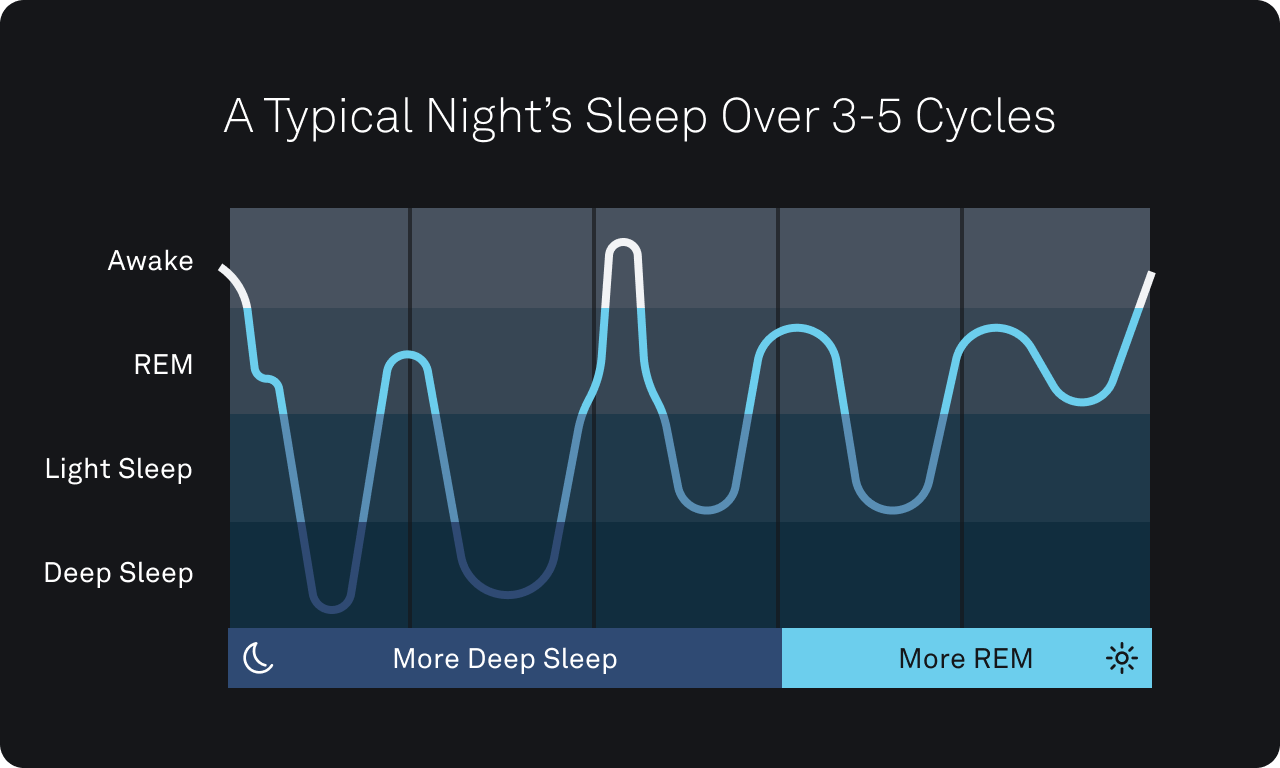
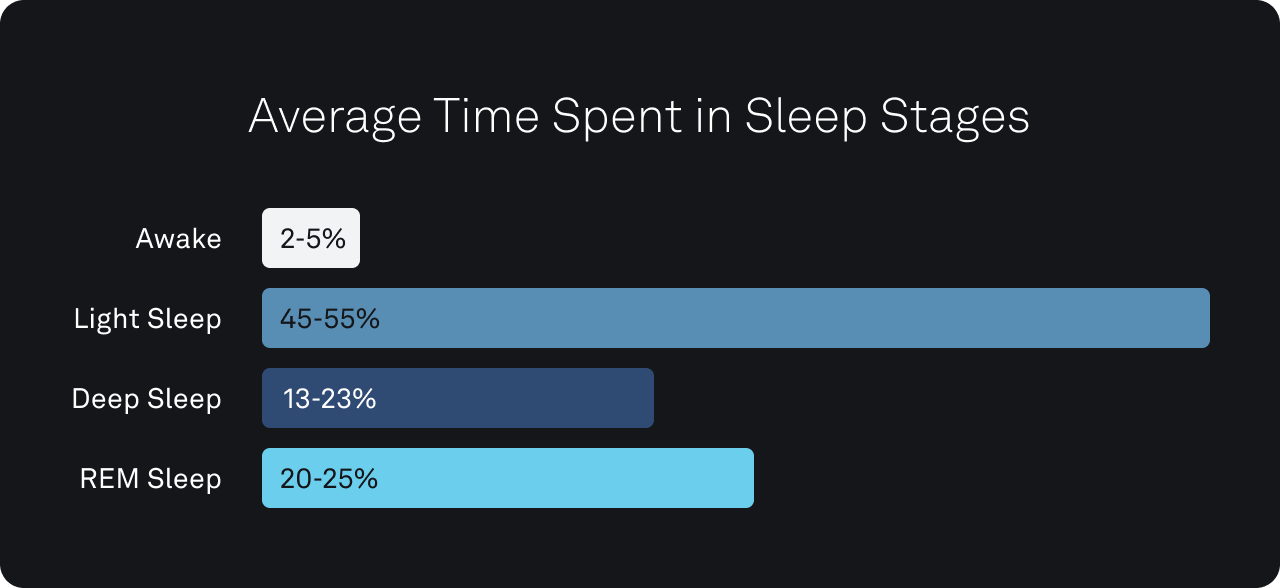
Overall, your body spends the majority of the night in light sleep. How much time you spend in REM or deep sleep can vary widely by individual, but below are the averages you can expect for each stage in a single night.
How Much Time Do You Spend in Each of the 4 Stages of Sleep?
How Oura Estimates Your Sleep Stages
Oura does not measure brain activity. It measures peripheral physiological signals — movement, heart rate, heart rate variability, respiratory rate, and skin temperature — that shift in reproducible ways with sleep state, and a machine learning model maps those signals onto the four reported stages.
Oura produces a hypnogram — a graph that maps your stages across the night — at a 30-second resolution that feeds your Sleep Score. You’ll see it in the Oura App displayed in five-minute aggregates. It’s helpful to understand your trends, but not a replacement for a clinical sleep study.
How Accurate is Oura Ring?
In an external validation study conducted by researchers at Brigham and Women’s Hospital comparing major consumer sleep trackers against PSG, Oura Ring was found to be the most accurate consumer sleep tracker tested for 4-stage sleep classification (Light, Deep, REM, and Wake). It achieved 76.3% agreement for 4-stage classification and 92% for 2-stage (sleep/wake) classification.
In this study, participants sleep wearing both the ring and full clinical polysomnography (PSG), the sleep-lab gold standard. The night is divided into 30-second segments called epochs — about a thousand of them in an eight-hour night. A trained technician scores each epoch from the PSG recording, the ring produces its own label for the same 30 seconds, and the two are compared one by one. “Accuracy” is simply the share of epochs where the ring and the technician agree. This is why the numbers are demanding: getting most of the night right still leaves plenty of room to disagree on individual 30-second windows.
Additionally, across multiple peer-reviewed studies comparing the Oura Ring against clinical sleep-lab recordings (polysomnography), the ring correctly detected sleep 94–98% of the time, with overall sleep/wake agreement of roughly 90–96%.
READ MORE: How Oura Measures Sleep and Validates Accuracy
Frequently Asked Questions About Sleep
What are the 4 stages of sleep?
There are four stages of sleep: Awake, Light, Deep, and REM (Rapid Eye Movement). These are also referred to as NREM (Non-Rapid Eye Movement) stages 1, 2, 3, and REM.
What happens in each stage of sleep?
- Awake: It’s normal to have short awake periods throughout the night. If you feel rested, these brief awakenings are not a concern.
- Light Sleep: Making up about half of your total sleep, this stage (NREM stages N1 and N2) is a time of relaxation as your heart rate and body temperature drop. It’s crucial for memory and creativity.
- Deep Sleep: This is the most physically restorative stage (NREM stage N3). Your body repairs and restores itself, with brain activity slowing into “delta waves.” It’s the hardest stage to wake from.
- REM Sleep: Your brain becomes very active, mimicking waking hours. This is when vivid dreaming occurs. REM sleep is vital for emotional health and learning, as your brain makes new connections.
What does a normal night of sleep look like?
A typical night involves four to five 90-minute sleep cycles. Each cycle progresses from awake to light, deep, and then REM sleep. Your body gets more deep sleep in the first half of the night, while REM sleep periods get longer in the second half.
How much deep sleep and REM should you get?
Most adults spend about 15–20% of the night in deep sleep and 20–25% in REM — but the exact split varies by person and night. Watch your trend over several nights rather than chasing one number. One thing worth knowing: deep sleep declines steadily with age, starting in early adulthood. Getting less of it at 60 than you did at 25 is expected.
How long is a sleep cycle?
About 90 minutes on average, and most adults move through four to five cycles a night. Each cycle mixes changing amounts of light, deep, and REM sleep rather than a fixed amount of each.
Can a wearable diagnose a sleep disorder?
No. Your Oura Ring can estimate your sleep stages and show patterns, but a diagnosis needs a healthcare professional and, when appropriate, a clinical sleep study.
RELATED: Why You Shouldn’t Stress About Getting the “Perfect” Night of Sleep