




Oura is advancing clinical practice for perimenopause with a new, scientifically-validated patient reported outcomes survey. Current assessment tools, which were developed and validated decades ago, measure symptom frequency and severity alone, without accounting for their effect on quality of life. The Menopause Impact Scale (MIS) establishes a new clinical premise: when any symptom, regardless of frequency or severity, is affecting a patient’s quality of life, it warrants clinical attention and management.
The MIS was designed for the modern healthcare environment. As women increasingly track their health between clinical encounters, we saw an opportunity to move from a visit-driven evaluation to a patient-driven, repeatable, digital survey that can be used alone or in concert with continuous biometric monitoring by Oura Ring.
Download the Oura Women’s Healthcare Guide
What is the Menopause Impact Scale?
The Menopause Impact Scale, available in the Oura App and for integration into clinical use, asks patients to reflect on twenty-two symptoms related to perimenopause and postmenopause. Patients select the response that best describes the impact each symptom has on their quality of life.
The instruction to patients is as follows:
This scale asks about common symptoms that women may experience.
For each item, select the response that best reflects how much that symptom has impacted your quality of life over the past two weeks.
- None: You don’t experience this symptom, or it doesn’t affect your day.
- A little: You notice it, but it doesn’t get much in the way.
- Moderately: It has a clear impact on your day-to-day life.
- Quite a bit: It strongly affects your daily life and routines.
- Extremely: It makes it very challenging to carry out your usual activities.
The MIS captures impact across seven symptom domains:
- Cognitive: Difficulty concentrating, takes longer to think things through, making decisions or solving problems feels harder than before, finding it harder to plan, organize or keep track of
- Body Image: Feeling unattractive or less confident in appearance, avoid certain activities due to body image concerns, worry about looking older
- Sexual Function and Vaginal Symptoms: Pain or discomfort with sex, decreased interest in sex, difficulty becoming aroused or lubricated, reduced sexual satisfaction, difficulty reaching orgasm
- Musculoskeletal Pain: Back pain, joint pain or stiffness, muscle pain or aches
- Hot Flashes: Daytime hot flashes, sudden heat or flushing, hot flashes at night or night sweats
- Sleep Maintenance: Trouble falling asleep, trouble staying asleep, waking up too early and cannot get back to sleep
- Urinary Tract Symptoms: Burning or pain when urinating, difficulty starting urination or weak stream
How to interpret the Menopause Impact Scale in clinical care
The MIS can be used to evaluate the impact of symptoms at a holistic level using the total score; it also provides information at the subdomain level for more precise discussions.
Total score: The total impact score is the sum of the seven subdomain means, giving a continuous range from 0 to 28.
Interpretation: To facilitate easy interpretation, total MIS scores are grouped into four impact levels based on the average domain impact:
- Minimal impact: 0 to <7
- Mild impact: 7 to <14
- Moderate impact: 14 to <21
- High impact: 21–28
For following the overall impact of symptoms on a patient’s quality of life, the total score may be sufficient. If individual subdomains have elevated scores compared to others, this can be seen in the subdomain score.
Each subdomain is given an impact score, which is the mean of completed items within each domain, giving subdomain scores ranging from 0 to 4. A subdomain score is available when at least half of items within that domain have responses.
Longitudinal use of the Menopause Impact Scale
The MIS was designed with repeated evaluation in mind. The Oura App provides a format for accessible, repeatable completion by a patient. A clinician can advise on the appropriate frequency of testing depending on the clinical situation or intervention. The total and domain score are then available as an exportable summary PDF which shows the longitudinal data trends.
Score trends can be used to track the impact and efficacy of perimenopause care plans including initiating a behavioral intervention, starting a new medication, or following other clinical guidance.
Patient experience within the Oura App
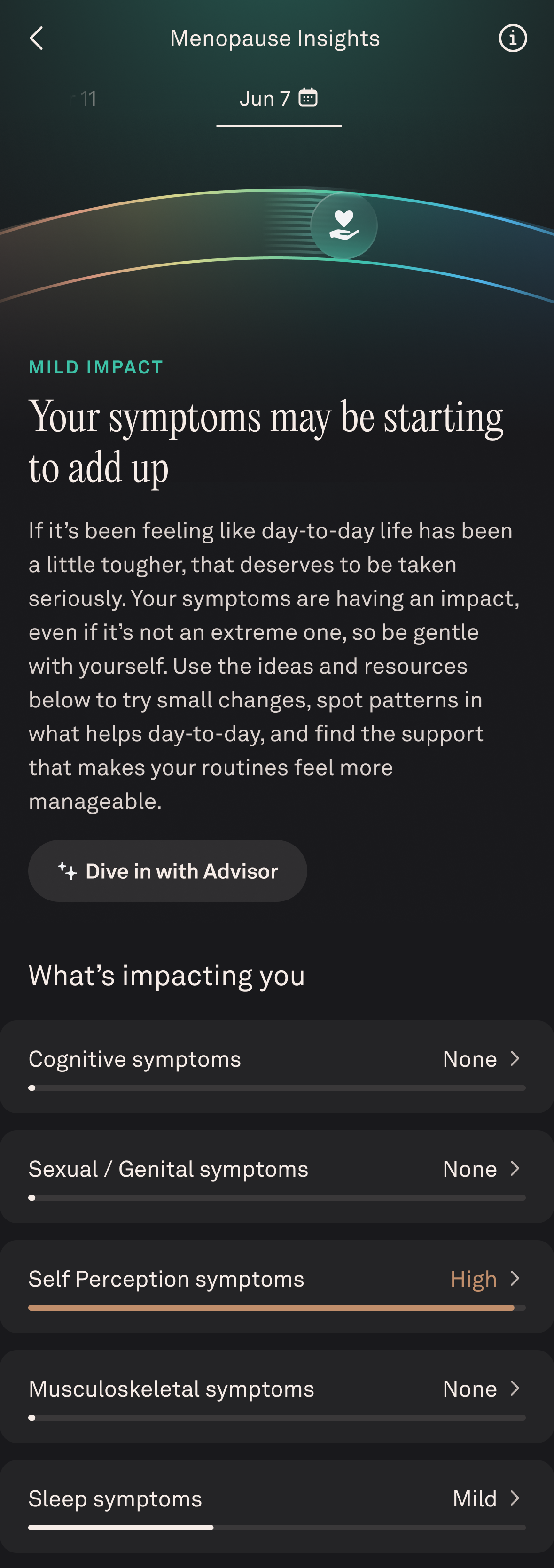
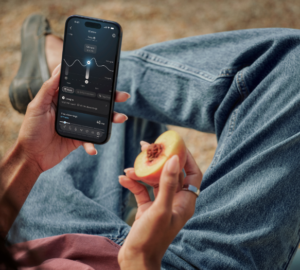
Within the Oura App, members have access to a glanceable summary of their MIS results and can retake the assessment whenever they choose. After their first completion, an automatic reminder is sent 30 days later to prompt reassessment.
Members can also chat with Oura Advisor, which draws from a broad foundation of established medical standards, research, and knowledge sources reviewed by Oura’s in-house team of board-certified clinicians and women’s health experts, and integrates biometric signals and long-term trends to deliver personalized, evidence-based guidance, including perimenopause. In between visits, a patient can learn background information about symptoms associated with menopause, as well as ask questions with the confidence that the answers will be evidence-based.
Key interpretive notes for clinicians:
The MIS measures perceived impact on quality of life, not symptom frequency or severity. A score reflects how much a given symptom is affecting the patient’s daily functioning and wellbeing, not how often it occurs or how physically intense it is. The instrument is evaluated across reproductive stages, so it can provide useful data in the setting of perimenopause, post-menopause, surgical menopause, or primary ovarian insufficiency.
These data are available as a PDF report, called the Menopause Impact Scale. It is downloadable and shareable by design. We built it to support — not replace — the clinical relationship. The goal is to give physicians better data and give patients a better way to share what’s actually going on.
LEARN MORE: Advancing Human Health with Oura: Bridging Everyday Life and Clinical Care