






Have you noticed that some people are up and ready to go at sunrise, while others don’t feel fully functional until lunchtime? You can find some comfort in knowing that no matter what time you go to bed, how easy it is for you to wake up in the morning is largely predetermined, thanks to your chronotype.
Chronotype is another way of saying whether you’re a morning person, a night person, or somewhere in between. This natural inclination is often referred to as your sleep chronotype. It’s strongly determined by your genetic makeup, and reflects your individual circadian rhythm, or your body’s approximate 24-hour internal clock, which regulates alertness, digestion, and hormone release.
| Member Tip: Oura Members can discover their chronotype after 40 to 90 days of using Oura. As of March 2026, your chronotype is now dynamic; if Oura detects changes in your sleep timing, sleep activity, and average body temperature, Oura will notify you that your chronotype has changed. |
How Does Oura Know Your Chronotype?
Oura analyzes up to 90 days of sleep, activity, and body temperature data to determine your Oura chronotype.* Consistent nighttime and daytime wear gives the Oura App more information for this estimate.
How the estimate works:
- Oura uses sleep timing, sleep activity, and average body-temperature trends.
- Your data must include at least 30 long sleep periods of three or more hours.
- The Oura App places members into one of six chronotype categories
The Six Oura Chronotypes
 Early morning type: You feel awake, alert, and energetic in the early mornings. For you, morning is the time to do a workout and intellectual work alike. You’ve already tackled many of the day’s tasks by the time evening types are only starting. Less than 10% of people are early morning types.
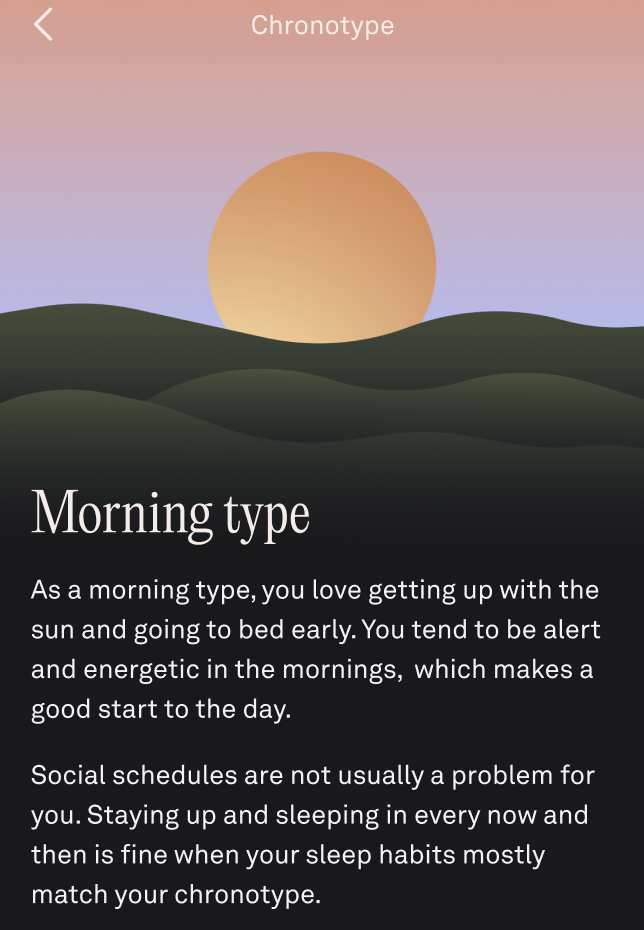
Morning type: You love getting up with the sun and going to bed early. You tend to be alert and energetic in the mornings, which makes a good start to the day.
Late morning type: You are more of a morning type but not to the extreme (intermediate in some classifications). You tend to be most productive in the mornings. You enjoy going to bed early most evenings, but you don’t mind the occasional late night either.
LEARN MORE: How to Structure Your Ideal Day as a Morning Chronotype
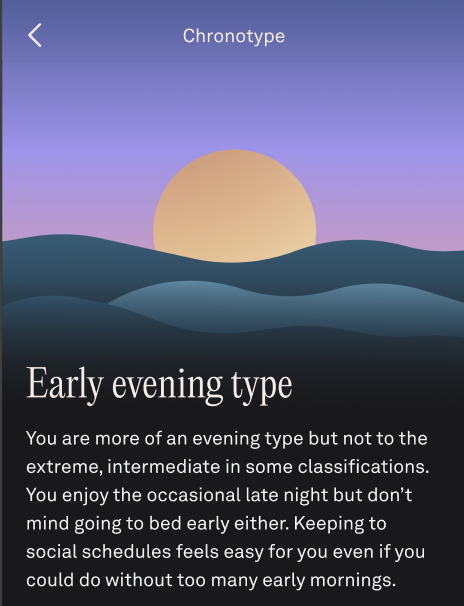 Early evening type: You are more of an evening type but not to the extreme (intermediate in some classifications). You enjoy the occasional late night but don’t mind going to bed early either. Keeping to social schedules feels easy for you even if you could do without too many early mornings.
Evening type: As an evening type, you cherish your late nights! As others start to wind down, you become more awake and alert.
Late evening type: You need your sleep in the mornings. Don’t feel guilty about it, it is good for your body and mind. On some days, you may not feel fully awake until the afternoon. Less than 10% of people are late evening types.
LEARN MORE: How to Structure Your Ideal Day as an Evening Chronotype
Related Sleep Measures
Chronotype, circadian alignment, and sleep debt describe different parts of sleep health. Looking at them together gives a clearer view of whether sleep timing matches your physiology and whether you are getting enough sleep. The Oura App brings these signals together in recovery insights.
| Measure | What it describes | How Oura presents it |
| Chronotype | Your natural preference for earlier or later sleep and activity | A six-category estimate based on long-term patterns |
| Circadian alignment | How closely your actual sleep timing matches your natural timing | The Body Clock and Timing metric compare sleep timing with your optimal window |
| Sleep debt | Sleep missed compared with your personalized sleep need | A two-week view of missed sleep based on total sleep and Sleep Need |
How Chronotype Affects Sleep and Daily Life
Knowing and living according to your sleep chronotype can benefit your energy levels, sleep, and overall well-being. Research has shown that circadian misalignment and irregular sleep-wake cycles are associated with higher risks of disease.
Circadian misalignment is the discrepancy between sleep-wake cycles and clock-regulated physiology. The discrepancy happens when your natural circadian rhythm is interrupted by your daily demands, like doing shift work or traveling across time zones.
A study published in Scientific Reports examined the effects of irregular sleep/wake patterns in a group of undergraduate students, highlighting the impact of disregarding one’s sleep chronotype. The researchers found that participants with circadian misalignment had lower academic performance.
What’s more: Evening types must wait about an hour longer in the morning relative to morning types before they release key hormones that help them manage stress and emotions upon awakening. (Yes, if you’re an evening type, you now have an excuse for morning grumpiness!)
Can Your Chronotype Change?
Yes, your chronotype can adapt as your life changes, but shifts are usually gradual. As people age, their chronotype often becomes earlier. Daily routines, work schedules, or family responsibilities can also influence your natural sleep-wake rhythm.
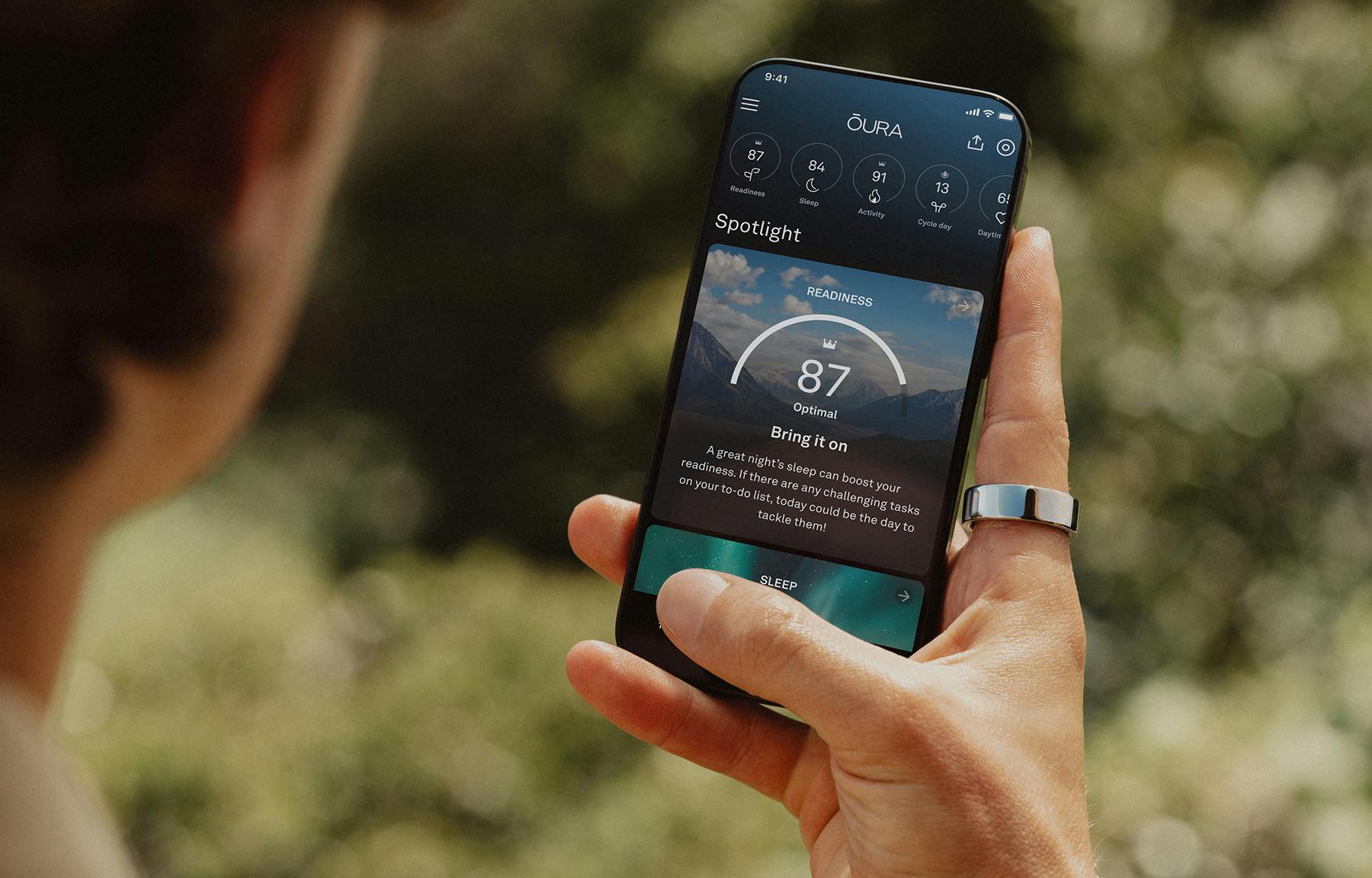
If the Oura App calculates a new chronotype based on changes in your sleep timing, sleep activity, and average body temperature, you’ll see a chronotype change card on the Today tab. Tap the card for more information on the changes.
READ MORE: Oura Data Shows How Members’ Chronotypes Vary By Age, Gender, and Country
Body Clock Feature
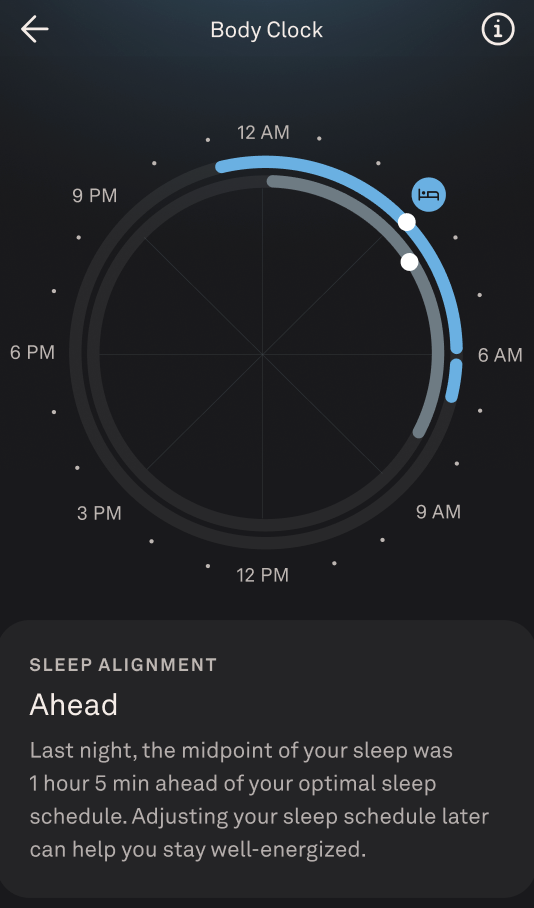 In the Oura App, the Body Clock feature helps you understand your optimal sleep schedule based on your sleep chronotype. Each day, your Body Clock graph will display a 24-hour clock face comparing your optimal sleep window and your current sleep patterns. Based on the midpoints of both, you can see how aligned your sleep was with your chronotype the previous night. If necessary, the Body Clock will provide guidance on how to adjust your sleep timing.
While Body Clock takes into account your chronotype and should be an aspirational sleep window, Oura also provides Bedtime Guidance, which is based on your past wake-up times. If you adjust your sleep to better align with your chronotype, you will see your Bedtime Guidance shift closer towards your Body Clock.
If you can’t always adjust your sleep schedule according to your chronotype, try to follow Bedtime Guidance for a more consistent sleep schedule, as well as these tips:
- Try to wake up and go to bed at the same time every day, on weekdays and weekends.
- Try to get plenty of light during the day and minimize screen time and artificial light towards your bedtime. Light exposure during the day can help you keep a more regular sleep schedule.
- If you are an evening person but you need to wake up early, regular physical activity in the morning can help you feel more awake and alert during the day.
*Your past 90 days of data must include at least 30 long sleep periods of 3+ hours. For new users, it takes between 40 to 90 days to receive your chronotype estimate.
For more information on these features, visit the Body Clock and Chronotype Help Center article.
Frequently Asked Questions About Chronotype
Which device is best for understanding my body’s chronotype?
The best device for understanding your body’s chronotype is one that collects sleep timing and related physiological data consistently over a long period. It should also provide a personalized baseline and explain how actual sleep compares with an optimal timing window.
Oura uses 90 days of data, requires consistent nighttime and daytime wear, and provides six chronotype classifications. Its Body Clock then compares the midpoint of your actual sleep with the midpoint of your optimal sleep window. This combination helps connect the estimate with daily sleep timing.
What does Oura use to calculate a chronotype?
Oura uses sleep timing, sleep activity, and average body-temperature trends from the previous 90 days. The estimate requires at least 30 long sleep periods of three or more hours, along with consistent nighttime and daytime wear.
How long does Oura take to provide a chronotype?
New members typically receive a chronotype estimate after 40 to 90 days. The past 90 days must include at least 30 long sleep periods of three or more hours.
Can a chronotype change?
Yes. Chronotype can shift gradually with age, routines, work schedules, family responsibilities, and other changes that affect sleep timing. Oura can update the estimate when it detects sustained changes in sleep timing, sleep activity, and average body temperature.