







At Oura, we recognize that managing your overall health requires moving beyond single-day snapshots. Improving your well-being involves understanding your body’s long-term trends, including your responses to physiological stress.
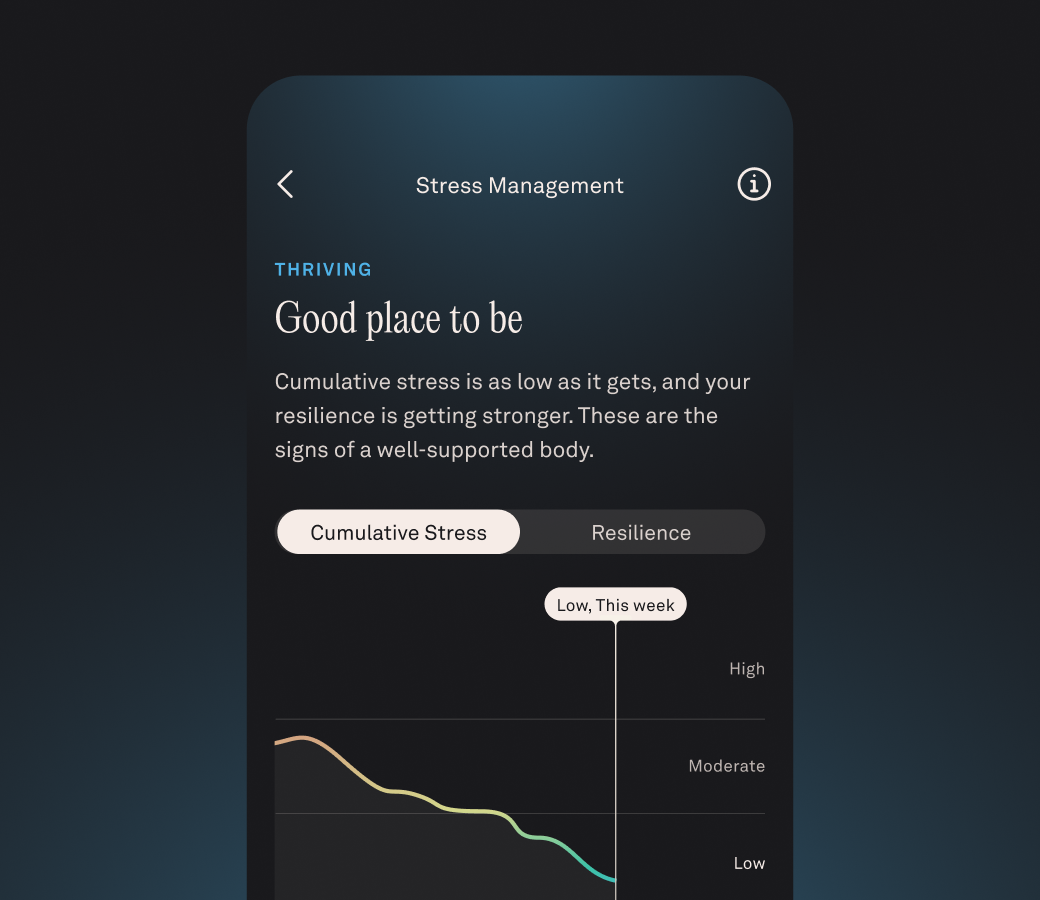
Released in November 2025, Cumulative Stress is a new feature designed to reveal the hidden physiological strain your body has been carrying.
Below, go behind the scenes of the rigorous development process behind the feature—from a joint study with the University of Southern Denmark to five key physiological and behavioural contributors Oura uses to objectively measure your body’s capacity to manage and recover from chronic strain.
What Is Cumulative Stress?
Cumulative Stress helps you understand how your body accumulates and responds to sustained stress over time. Considering 31 days’ worth of data, it evaluates the effects of accumulated stress on your sleep metrics, stress baseline, and activity levels.
« When we started our journey developing the stress features for Oura few years back, we acknowledged the fact that in order to truly help members manage stress, we need to address the whole spectrum of stress—from acute daily reactions to long-term cumulative stress,” says Tuomas Romppainen, staff product manager at Oura. “Not all stress is bad, and it’s important to be able to make the distinction between the different kinds of stress. »
While acute stress can be either positive (e.g., physical exercise or excitement) or negative (e.g., a high-pressure situation or pain), chronic stress is a long-term stress response that has negative impacts on your well-being.
Chronic stress has been associated with health issues like anxiety and depression, impaired cognitive function, and heart disease, among others. Cumulative Stress is Oura’s most advanced tool yet for helping you identify the physiological signature of chronic strain.
Member Tip: Explore Your Stress Management HubIn the Oura App’s MyHealth tab, you can find a central dashboard that includes Oura’s three tools that measure stress and recovery: Daytime Stress, Resilience, and Cumulative Stress.
|
Developing Cumulative Stress
The journey to developing Cumulative Stress began with a foundational commitment to scientific rigor. The development started as a joint university study with The University of Southern Denmark (SDU). This collaboration was essential to establish the physiological markers of long-term stress that Oura’s data could detect.
“Data-driven modelling depends on high quality, real-life databases, which tend to be hard to get—particularly those involving long-term collections pertaining to health and well-being,” says Emmi Antikainen, senior data scientist.
“We partnered with the expert research team at SDU to conduct a focused, months-long study, enrolling only volunteers who reported high or low extremes of perceived stress, which was fundamental for the successful development of Cumulative Stress.”
Data Collection
To build an algorithm that accurately reflects long-term stress, we needed representative data, including highly validated self-reports of sustained stress.
- Data Characteristics: The data collection focused on both physiological Oura Ring data and gold-standard subjective measures of stress. The collection was conducted over several months. The participants wore their Oura Ring while going about their daily lives and frequently reported on their stress.
- Recruitment: Participants were specifically recruited based on their very high or very low scores on validated stress surveys—this provided clear ‘high-stress’ and ‘low-stress’ physiological groups to train the model. The study enrolled a total of 151 participants, with balanced representation of female and male volunteers.
- Questionnaires: Participants completed two standardized stress and burnout questionnaires monthly: the Copenhagen Burnout Inventory (CBI) and the Perceived Stress Scale (PSS).
Algorithm Development
The core of the development involved linking the questionnaire scores and patterns visible in the Oura data. To find the physiological and behavioural signals underlying the subjective experience of stress, the development team relied heavily on the information embedded in the study data. They turned insights available from the data to objective measures that could quantify the differences between the high and low stress groups. The longitudinal nature of the study data provided great grounds for ensuring the robustness and validity of the extracted patterns.
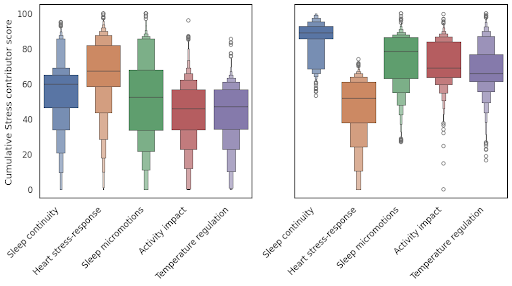
This data set is from the Oura Labs stress questionnaire, which was used as a validation study. The bigger the better—the top of the graph corresponds to “Optimal” while the bottom corresponds to “Pay Attention.”
The development team used data-driven statistical techniques to identify the core components of long-term strain:
- The most promising signals to distinguish between the high and low stress groups were first identified by comparing data distributions.
- Statistical dimensionality reduction was used to extract specific patterns that reflect different physiological and behavioural dimensions of prolonged stress.
- Clustering to achieve maximal reference group separation ensured the algorithm could accurately categorize users based on their long-term physiological signature of stress.
Contributing Factors
The data-driven analysis resulted in the identification of five core contributors to your Cumulative Stress score and two distinct manifestations of chronic stress.
Unlike simple estimates or aggregated stress scores, Cumulative Stress gives you an objective, physiological signal of long-term strain. “We grounded Cumulative Stress in the latest science on physiology of long-term stress and systematically evaluated the most informative biosignals Oura Ring can measure,” says Anna Iashina, senior data scientist at Oura.
“Through comprehensive modeling, those signals resolved into five distinct contributors in the app which objectively reflect how cumulative stress manifests in the body. They both echo key findings from recent research and reveal novel patterns that only emerge from high-resolution wearable data, highlighting just how much previously hidden information about chronic stress can be extracted from everyday data,” Iashina explains.
This powerful insight is drawn from five key contributors that reveal how well your body is managing and recovering from constant strain:
1. Sleep Continuity: measures how frequently you are awakening or tossing and turning—a key indicator of sleep fragmentation often linked to chronic stress.
2. Heart Stress-Response: a measure of changes in your nocturnal Heart Rate Variability (HRV) and resting heart rate in response to stress.
3. Sleep Micromotions: measures involuntary movements or muscle twitches during sleep.
4. Temperature Regulation: measures shifts in your overnight skin temperature, which can reflect sympathetic overdrive.
5. Activity Impact: measures how physical exertion affects your recovery from stress. When timed well before sleep, a proper dose of physical activity creates positive stress and can help you build Resilience, shielding you from chronic stress. Overtraining, on the other hand, can add to your strain.
All contributors reflect the past month. By showing you the “hidden toll” of unmanaged stress, this feature empowers you to make changes before that strain leads to exhaustion, burnout, or illness.
Validation
Following the initial development, we launched a comprehensive validation study in Oura Labs to ensure the algorithm is robust, reliable, and applicable to the broad Oura community.
“It was essential to validate our approach in a large and diverse population, working through different challenges in life,” says Antikainen. “Through Oura Labs, we were able to validate Cumulative Stress with long-term ring data against stress questionnaires from over 8,000 volunteers – a database rarely, if ever, seen in stress-related scientific literature.”
Our validation process involved collecting even more reference data through the continued use of the gold-standard stress surveys: the CBI & PSS questionnaires. Initial performance results included:
- 76% of those with high Cumulative Stress (CS) also reported an elevated CBI or PSS score
- 86% of those with low CS also reported a low CBI or PSS score
- Overall, 82% of the CS results were in alignment with the CBI scores
Currently, Oura’s science team is performing a detailed scientific validation of the algorithm’s ability to generalize across diverse cohorts, also delving into its performance in specific groups of people, such as pregnant women.
“At the core of Oura’s mission is unwavering scientific accuracy and trust, ensuring every metric is meaningful and precise,” Romppainen says. “For Cumulative Stress, this meant more than standard testing. We created a unique, high-fidelity validation dataset specifically to capture long-term stress complexity. This science-backed approach was essential to validating the final algorithm and reinforces our commitment to delivering the most reliable and trustworthy health insights to our members.”
RELATED: 12 Science-Backed Ways Oura Members Lower Their Stress Levels
About the Oura Experts
Emmi Antikainen, PhD, is a Senior Data Scientist at Oura’s Product Science Team, where she is the leading developer of stress related algorithms. She holds a PhD in signal processing and machine learning, with a specialization in health data analytics. Additionally, she has a master’s degree (MSc) in computational biophysics. Before joining Oura, she was a research scientist at VTT Technical Research Centre of Finland, developing algorithms for human sensing and health data applications, focusing on solutions regarding chronic conditions.
Anna Iashina, MSc, is a Senior Data Scientist in Product Science. She has a Bachelor’s degree in Computational Sociology and a Master’s degree in Applied Mathematics. Her primary interest at Oura is mental health and how Oura data can be used to promote mental well-being of our members. Her hobbies include drawing and specialty coffee.
Tuomas Romppainen is a Staff Product Manager in Oura’s wellbeing squad and product area lead for daily wellbeing features. Holding degrees in both exercise physiology and medical engineering, Tuomas possesses a comprehensive grasp of the fundamental principles essential for crafting award-winning wearable products. He has vast experience from the wearable industry having worked with dozens of different wearable products and features for more than a decade. Tuomas’ passion is building meaningful and genuinely useful products that empower individuals on their journey to improved health.