

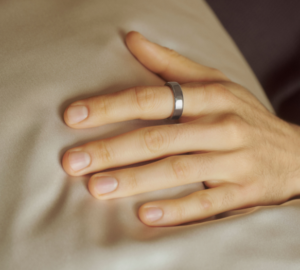

As you close your eyes and prepare to doze off, your Oura Ring gets ready to track your entire night of shuteye. In the morning, you wake up to data showing how long you spent in each stage of sleep, plus a Sleep Score that sums up how well you slept. But you’re probably wondering: how does it do that — accurately?
In short: Oura Ring captures heart rate, movement, and temperature from your finger to estimate your sleep stages and build your Sleep Score.
Below, we break down how Oura’s sensors, design, and algorithm make that possible.
LEARN MORE: What Are the Stages of Sleep?
Key terms: Oura Tracking Sleep
| Term | Definition |
| Photoplethysmography (PPG) | An optical method that uses light to measure blood-volume changes. Oura uses infrared and green PPG to capture HR, heart rate variability, and respiration. |
| Hypnogram | A graph of your sleep stages across the night: awake, light, deep, and REM. |
| Sleep Score | A single 0–100 summary of your night, built from your sleep stages and other signals. |
| Polysomnography (PSG) | The clinical gold-standard sleep study, done overnight in a lab with sensors attached to your head and body. |
How Oura tracks your sleep, at a glance
Sensors (infrared PPG · accelerometer · skin-temp sensor)
↓
Signals (heart rate · HRV · respiration · movement · temperature)
↓
Machine-learning sleep-staging algorithm
↓
Hypnogram + Sleep Score
What Makes Oura’s Sleep Tracking Accurate?
Unlike wearables originally built as activity trackers, Oura was engineered for sleep from the start, and its algorithm is trained and validated against clinical polysomnography, the gold standard for sleep tracking.
In a foundational 2021 study published in Sensors, researchers compared data from Oura Ring to data from polysomnography (PSG), the clinical gold standard for measuring sleep across 440 nights and 106 individuals (over 3,400 combined hours). The findings: while a simple motion/accelerometer model achieved only 57% accuracy for 4-stage sleep classification, adding PPG-derived autonomic nervous system (ANS) signals and temperature features boosted 4-stage sleep classification accuracy to 79% and 2-stage (sleep/wake) accuracy to 96%
In 2024, University of Tokyo researchers ran one of the largest wearable validation studies to date, evaluating Oura’s Sleep Staging Algorithm 2.0 against ambulatory polysomnography across 96 participants aged 20–70 and 421,045 30-second epochs, with up to three nights per participant. For 2-stage (sleep vs. wake) classification, Oura achieved 91.7–91.8% accuracy, with 94.4–94.5% sensitivity and 73.0–74.6% specificity — the ring is better at recognizing sleep than at recognizing wake, which is characteristic of the method.
RELATED: The Accuracy Advantages of Finger-Worn Wearable Devices
Built by sleep experts
Oura is a company founded on sleep, with a team of world-class sleep experts dedicated to studying sleep physiology and advancing the science behind it. Oura Ring was designed to help members understand their own sleep and to serve researchers as a tool.
How Does Oura Know What Sleep Stage I’m In?
Once Oura knows you’re asleep, it builds a sleep-stage graph called a hypnogram.
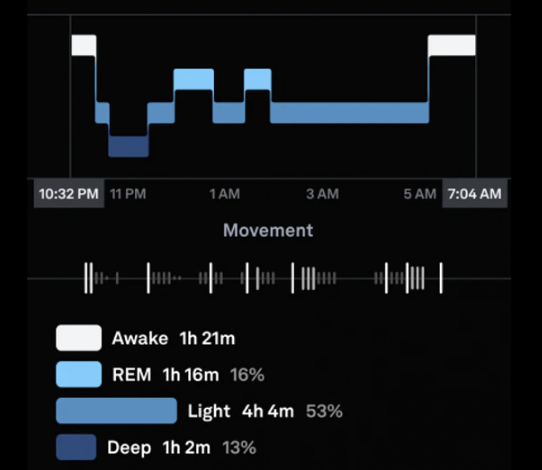
You might be wondering: how is a hypnogram built? At the end of the night, Oura’s algorithm splits your sleep into 30-second windows and labels each one awake, light, deep, or REM based on the dominant pattern across your heart rate, breathing, movement, and temperature. Strung together, those labels form your hypnogram and feed your Sleep Score.
Each stage has a clear physiological signature Oura looks for:
| Sleep stage | Biosignals Oura detects |
| Light | Muscles relax and may twitch; respiration slows; heart rate drops; finger temperature rises (compared to wake) due to vasodilation |
| Deep | Movement is suppressed; heart rate and respiration are very stable. |
| REM | The body goes still; heart rate and respiration rise. |
How Does Oura Differ From a Professional Sleep Study?
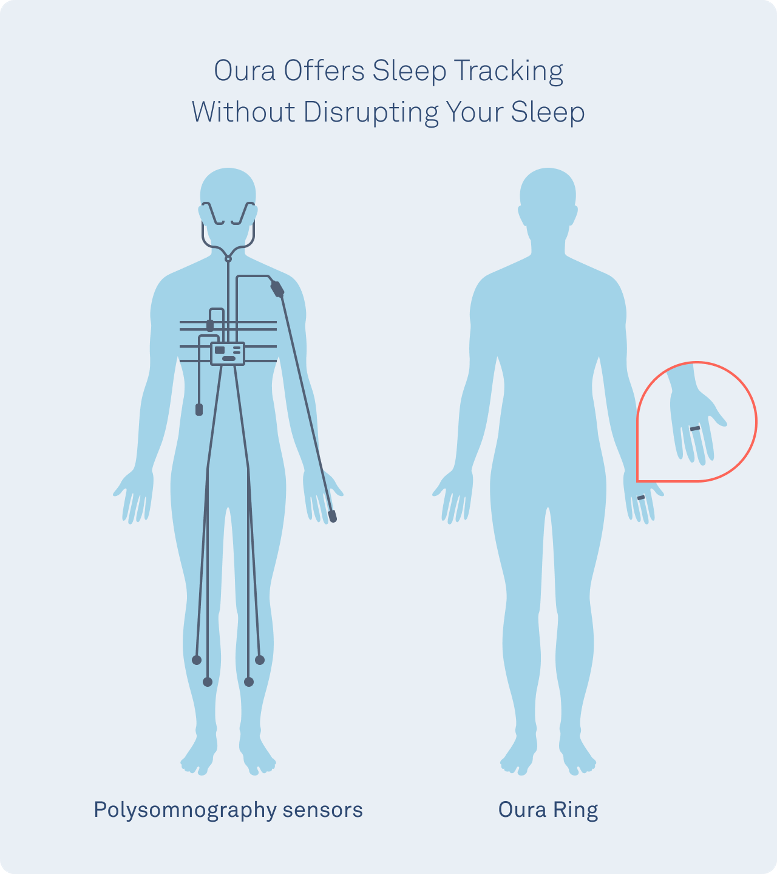
PSG is the clinical gold standard. Oura cannot directly measure the signals captured by PSG, such as brainwaves. Instead, it measures peripheral and autonomic signals that change as the body enters one sleep stage or another, enabling it to infer sleep stages with high accuracy. Oura has several practical advantages over PSG:
- Fewer sensors. A lab PSG wires you up head to toe, which is great for diagnosing conditions but disruptive to sleep. Oura is a comfortable ring.
- More data. PSG usually captures a night or two; Oura measures every night, so you see the full picture over time.
LEARN MORE: Why Sleep Matters
Frequently Asked Questions About Sleep Tracking
Oura claims “95% Sleep Staging Accuracy compared to a clinical sleep lab.” What does this percentage actually measure?
In a validation study, you sleep one or more nights wearing both the ring and full clinical polysomnography (PSG), the sleep-lab gold standard. The night is then chopped into 30-second segments called epochs—roughly 900 of them in an 8-hour night. A trained technician labels each epoch from the PSG, the ring produces its own label for the same epoch, and the two are compared one by one. “Accuracy” is simply the share of epochs where the ring and the technician agree. This is why the numbers are demanding: getting most of the night right still leaves plenty of room to disagree on individual 30-second windows.
What sensors does the Oura Ring use?
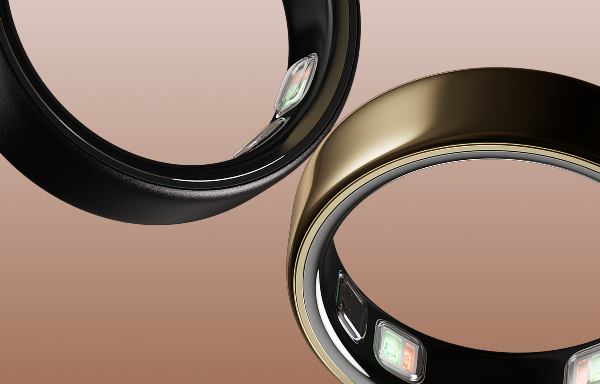
Three, all on your finger: an optical (PPG) sensor for heart rate, HRV, and respiration; an accelerometer for movement; and a temperature sensor. Combining all three is what allows Oura to tell sleep stages apart more accurately than movement-only trackers.
LEARN MORE: How Oura Measures Sleep and Validates Accuracy
About the Oura Expert
Raphael Vallat, PhD, is a senior machine learning data scientist at Oura. He previously worked as a sleep researcher in the Center for Human Sleep Science at University of California Berkeley (Prof. Matt Walker‘s lab). He has published extensively on the topic of sleep and human health, and his work has been featured in several major news media and podcasts. In his free time, you can find him enjoying precious moments with his amazing wife and daughter, playing music, or hiking with friends.