






When stressful thoughts consume your day, it can feel as though stress is strictly a mental problem. The reality is that stress materializes as both emotional and physiological symptoms—your brain and body are inseparable.
Your body’s stress response happens in two stages. The first is driven by your autonomic nervous system (ANS). Within seconds, nerve signals and a burst of adrenaline raise your heart rate and speed up your breathing. The second stage is slower: your brain activates the HPA axis, a chain that runs from the hypothalamus to the pituitary gland to the adrenal glands, which then release cortisol. Cortisol levels peak about 15 to 30 minutes later, raising your blood sugar so your body has energy to deal with the stressor.
Knowing how your body uses these two systems to react to different situations can help you build awareness and identify practices that transform your stress reaction into a reasoned response.
| Member Tip: Oura members can track their daily stress levels using the Daytime Stress feature, see how well they’re recovering over two weeks with Resilience, and view a 31-day picture with Cumulative Stress. |
Stress vs. Rest
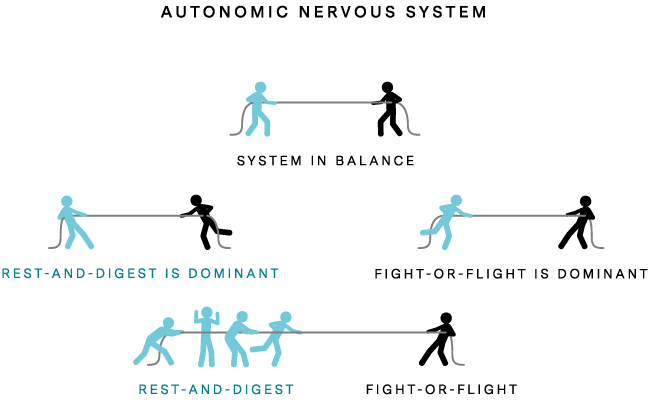
The ANS functions like a tug-of-war game between two subsystems: your activation (sympathetic nervous) system and your rest (parasympathetic nervous) system. Both regulate essential body functions like heart rate, respiratory rate, and digestion.
Your sympathetic nervous system is well known as the driver of your activating, fight-or-flight response, while the parasympathetic nervous system kicks in during calmer moments—like during periods of Restorative Time on Oura—as your rest-and-digest network.
Both systems dial their activity up or down using messages from your brain, nerves, and circulating hormones to send the signal all over your body. These systems can be active at the same time, or one can take over and dominate the other.
When activated, they trigger a cascade of changes in your body:
- If your fight-or-flight system starts to dominate, there are some rest-and-digest functions that stop altogether (e.g., digestion pauses when you’re running), while others simply scale back. At the same time, other body functions scale up (like an increased heart rate or increased respiratory rate) to respond to the fight-or-flight signal your body is sending.
- When your rest-and-digest system takes over, your body sends a signal that it is safe for some organs to get to work unimpeded, while others start to relax; you may see this reflected in increased digestion or a slower heart rate.
| Fight-or-Flight (Sympathetic) | Rest-and-Digest (Parasympathetic) |
| Resting heart rate increases | Resting heart rate decreases |
| Heart rate variability (HRV) decreases | HRV increases |
| Respiration speeds up | Respiration slows |
| Blood flow increases to muscles and lungs | Blood flow increases to reprioritized digestive system |
| Blood flow decreases to deprioritized areas | Organs resume their day-to-day functions |
| Stress hormone levels rise | Stress hormone levels fall |
READ MORE: How Stress Affects Your Sleep
Cortisol and the HPA Axis: Your Body’s Slower Stress System
Your autonomic nervous system usually reacts in seconds, while your endocrine (hormonal) stress response can take minutes and last longer.
That response runs through the HPA axis, named after the three structures involved: the hypothalamus, pituitary gland, and adrenal glands. When your brain registers a stressor, the hypothalamus signals the pituitary, the pituitary signals the adrenals, and the adrenals release cortisol into your bloodstream.
Cortisol then does several things: it increases blood glucose levels so your muscles and brain have fuel, heightens alertness, and temporarily deprioritizes functions you don’t need in an emergency (such as digestion, reproduction, and some immune activity).
Once the stressor is over, cortisol signals back to your hypothalamus and pituitary to shut down the cascade, a feedback loop designed to return you to baseline. However, chronic stress can interfere with this process.
RELATED: Your Path to Inner Peace: 10 Ways to Improve Vagal Tone & Reset Your Nervous System
Why Cortisol Peaks in the Morning
Cortisol runs on a daily schedule—and that schedule is part of what gets you out of bed.
Your cortisol is lowest around midnight. It begins climbing in the early hours and peaks roughly 30 to 45 minutes after you wake, a pattern researchers call the cortisol awakening response. From there, it declines across the day, reaching its low point again overnight.
This tends to contradict how cortisol is understood in popular culture. It isn’t a hormone that spikes when you’re stressed and otherwise doesn’t change. It’s a hormone with a rhythm, and that rhythm is doing useful work. As stress researcher Bruce McEwen put it, “we would not live very long or well without our cortisol.”
It’s also why a single cortisol reading tells you very little. Levels shift within minutes, so one measurement—taken at an unknown point in your daily curve — can’t tell you whether your rhythm is healthy. What matters is the shape of the curve over time.
If that sounds familiar, it’s the same principle behind reading your HRV: the information is in the pattern, not in any one number.
LEARN MORE: HRV and Stress: What HRV Can Tell You About Your Mental Health
Signs of Chronic Stress on Your Body
Chronic stress tends to show up as a set of symptoms that seem unrelated until you know what connects them—the stress system is made to switch on briefly and then stand down, instead of running most of the time.
Physical signs commonly associated with prolonged stress include:
- Sleep that’s disrupted or unrefreshing, even at a normal duration
- Getting sick more often, or taking longer to recover
- Digestive changes
- Persistent muscle tension, headaches, or jaw clenching
- Appetite changes in either direction
- Fatigue that rest doesn’t resolve
- Mood changes including irritability, anxiety, or depression
- Poor concentration and cognitive fog
What Chronic Stress Can Look Like in Your Data
Some of the earliest signs are measurable before they’re noticeable. Because your body keeps running its stress response overnight, the pattern often shows up in metrics captured while you sleep:
- Resting heart rate drifting above your personal baseline
- HRV trending below your usual range
- Body temperature deviating from your normal
- Sleep efficiency declining, or your sleep becoming more fragmented
None of these mean much on their own, for the same reason a single cortisol reading doesn’t—any one night can be thrown off by a late meal, a hard workout, or alcohol. A sustained shift across several of them at once is the more meaningful signal.
These patterns describe physiological stress, not a diagnosis. If you’re experiencing symptoms that concern you, speak with a healthcare professional.
Finding Balance
Life’s stress levels naturally fluctuate. When your body remains in a stressed-out, fight-or-flight mode over long periods of time, it can take a toll on your health by slowing your recovery time, weakening your immune system, and impacting your mental state.
Our ANS was designed to help us deal with brief episodes of high-intensity stress—a sudden threat, a physical emergency—but our modern lifestyle contains multiple chronic stressors that rarely shut off (e.g., job pressure, balancing childcare and work, sleep deprivation, and constant device stimulation).
When stress becomes chronic, the problem isn’t simply that cortisol goes up and stays up. Researchers describe the pattern as dysregulation: the daily curve flattens, or cortisol stays high when it should fall, or the system fails to mount a response when one is needed. All three carry a cost.
The cumulative wear from running this system too hard for too long is called allostatic load. It’s the price your body pays for staying adapted to demands that never let up, and it’s associated with changes across metabolic, cardiovascular, and immune function.
It’s all about balance. You don’t want your fight-or-flight system to be in a constant state of activation, but you also don’t want it to remain inactive—it is essential for your survival, your ability to respond to stress, and to maintain your body’s equilibrium.
Managing Your Stress
We are often unaware of the tug-of-war inside our ANS because it functions involuntarily and reflexively. Becoming more in tune with the physiological effects of stress can help you regulate your response or deploy strategies to bring you back into balance.
Check out these tips to identify and reverse imbalances sooner:
- Become more self-aware: Techniques like meditation can help you become more in touch with how activated or relaxed your body is, and meditation has been demonstrated as an effective way to improve cortisol levels and reduce stress
| Member Tip: You can access guided meditations and breathing exercises under the Explore content on the Oura App. Taking a moment during the day also offers an opportunity to reset imbalances when you sense them and may even improve your sleep. |
- Sense imbalances sooner: Consider how wearables, like Oura, can give you the opportunity to follow patterns of stress within your body and measure their impact more objectively. By monitoring your HRV, you can get an insight into how your ANS is doing. Use the Trends view to see how your HRV changes over time, or in response to certain life events.
- Improve your resilience: Increasing your fitness level and improving your sleep boosts your body’s ability to bounce back from stressful periods. If you’re looking for ways to rest and restore, try these science-backed ways to lower stress.
Frequently Asked Questions About Cortisol and Stress
What is the HPA axis?
The HPA axis is the hormonal pathway your body uses to respond to stress, named for the three structures involved: the hypothalamus, the pituitary gland, and the adrenal glands. When your brain registers a stressor, these three signal each other in sequence, ending with the release of cortisol. The system includes a built-in feedback loop that shuts it down once the stressor passes.
Does chronic stress always mean high cortisol?
No. Chronic stress is better described as dysregulation than as simple elevation. Some people show cortisol that stays high when it should fall; others show a flattened daily curve, or a blunted response to new stressors. All of these represent a system that isn’t cycling normally, and a single high or low reading doesn’t distinguish between them.
What are the signs of high cortisol?
Prolonged cortisol elevation is commonly associated with disrupted sleep, fatigue that rest doesn’t resolve, digestive changes, appetite changes, more frequent illness, and difficulty concentrating. These symptoms overlap with many other conditions, so they aren’t diagnostic on their own. Persistent or severe symptoms are worth discussing with a healthcare professional, who can order testing if appropriate.
Can a wearable detect cortisol?
No consumer wearable, including Oura, measures cortisol directly—cortisol is assessed through blood, saliva, or urine testing. What a wearable can measure are signals shaped by the same stress response: heart rate, heart rate variability, body temperature, and sleep quality. Those give you a picture of how your body is responding to stress over time, which is different from a hormone measurement.
What is allostatic load?
Allostatic load describes the cumulative physiological cost of adapting to repeated or ongoing stress. Rather than measuring one hormone at one moment, it captures the wear that accumulates when systems designed for short-term activation stay engaged long-term. Higher allostatic load has been associated with changes across metabolic, cardiovascular, immune, and cognitive function.